‘World’s First Robot Sports League’ Plots Global Expansion
Hero Esports plans to take its CyberHero league to eight cities worldwide initially
Posted On: September 14, 2026 By :CyberHero, which describes itself as “the world’s first global humanoid robot sports league,” has officially launched in Riyadh, Saudi Arabia. At the same time, Chinese esports company Hero Esports, which hosts the events, has announced plans to bring the league to eight cities around the world.
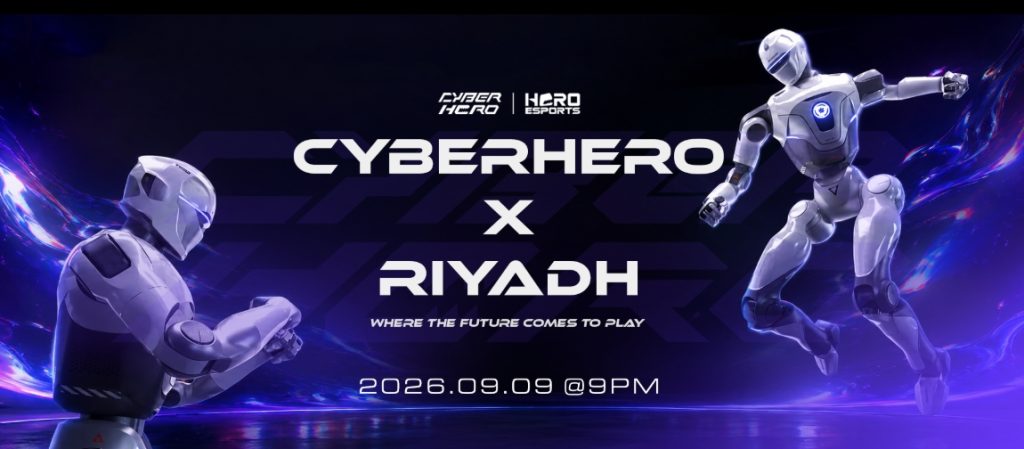
The inaugural event in Riyadh was the first in the new CyberHero series, offering a preview of the competition format, personalities, and broader vision for the new global robot sports property.
CyberHero x Riyadh was marketed as the Middle East’s first humanoid robot combat (kickboxing) event, featuring EngineAI T800 humanoid robots competing inside a purpose-built arena. Standing approximately 1.73 metres (5’6″) tall and weighing between 75 and 85 kilograms (165 to 185 pounds), the T800 features 29 articulated joints and is capable of walking, running, punching, kicking, turning, recovering after falls, and even dancing.
Hero Esports plans to bring the global circuit to four regions: the Middle East, Europe, the Americas and Asia. It is expected that two of the eight stops will be in the Middle East, and each competition is designed to explore how humans, AI and robots can increasingly work together.
“CyberHero was born from a bold idea about the future of competition: that robots can be pushed to test their limits, break new boundaries and improve through data generated in competition,” said Danny Tang, co-founder and CEO of Hero Esports. “That is one of the lessons we have learned from esports, and it is also a responsibility we see for Hero Esports over the next decade — to use competition to drive innovation and progress.
“We are now establishing a global technology lab at our Shanghai headquarters to bring together technical expertise and talent from around the world.”
League Ambitions
CyberHero ultimately operates using a team-based competition model, bringing together builders (who design and engineer the robots), coders (who develop and train the intelligence behind them) and drivers (who make live decisions and put the team’s capabilities to the test in the physical arena).
Combining sport, technology, gaming culture and live entertainment, the league will expand into additional disciplines as humanoid robot capabilities develop. In the long term, it aims to develop a global competitive platform that grows in parallel with the advances in physical AI.
As it continues to build out the global circuit, Hero Esports is seeking host cities and venues, robotics and technology suppliers, universities to provide teams and research, and commercial partners across tourism, sport, entertainment and music.
Launch Event
The inaugural CyberHero x Riyadh event was invite-only, with MENA creator AboFlah and Saudi sports creator Bashar Arabi going head-to-head as managers of the two competing teams (Team FBA and Team AL Majd). Other creators and personalities participating in the show included Bilal Fadili (an Algerian TikTok and Twitch streamer), Dubai-based creator Ahmad AlKhateb and Hong Kong-based professional fighting game player Chan “Micky” Pak Yin (who represents Team Falcons in Street Fighter 6 competitions), as well as electronic music producer and DJ Tokyo Machine.
In the first humanoid robot combat event lasting nearly two hours, Team FBA beat Team AL Majd 4-3 after seven rounds. The robots fought off against each other in a purpose-built octagonal arena, and were controlled by their operators throughout.
“I warmly welcome the choice of Riyadh by Hero Esports for the first CyberHero event,” said Saudi Esports Federation Chairman HRH Prince Faisal bin Bandar bin Sultan al Saud. “This is testament to the passion of our fans and Saudi Arabia’s ongoing commitment to esports as a thriving sector and entertainment choice. The energy at CyberHero x Riyadh created new boundaries for audience experience and competition.”
Hero Esports
Backed by Savvy Games Group and Tencent, Hero Esports is Asia’s largest esports company. Each year, it organizes more than 7,000 esports competitions and reaches hundreds of millions of fans across the world.
It operates and produces major esports leagues and tournaments across titles such as Honor of Kings, Peacekeeper Elite, League of Legends and VALORANT. It also serves as a China Partner of the Esports World Cup.
Furthermore, the company entered the Guinness World Records last year for achieving the largest attendance for an esports event, namely the Honor of Kings 2025 King Pro League Grand Finals, when more than 62,000 finals packed inside Beijing’s Bird’s Nest stadium.
Alongside CyberHero, Hero Esports plans to establish a CyberHero Saudi–China Scholar Program, which will provide opportunities for up to 30 Saudi students to visit China and experience the country’s developing robotics and physical AI ecosystem firsthand. designed to foster deeper connections between young talent and the robotics ecosystems of the two countries.
Beyond esports, Hero Esports has expanded into a broader live entertainment and cultural experience offerings spanning gaming, technology, music and pop culture. Its team has recently provided broadcasting support for both the Jakarta Asian Games and the Hangzhou Asian Games, and last year diversified into the music festival space with its “Tomorrowland” brand.
Humanoid Sports’ Emergence in China
China is currently leading the way in humanoid sports, with Beijing hosting the inaugural World Humanoid Robot Games in August 2025 and EngineAI staging the opening event of its T800 robot fighting league in Shenzhen on July 16 this year.
Meanwhile, in April, two robots built by smartphone maker Honor broke the human half-marathon world record by seven minutes in the second Beijing E-Town Half Marathon and Humanoid Robot Half Marathon in China.
At the time, the victorious humanoid, which came equipped with an autonomous navigation system, clocked a time of 50 minutes and 26 seconds on the 13-mile course in Yizhuang, beating the human world record of 57 minutes and 20 seconds that was set by Uganda’s Jacob Kiplimo in Lisbon only a month before that.
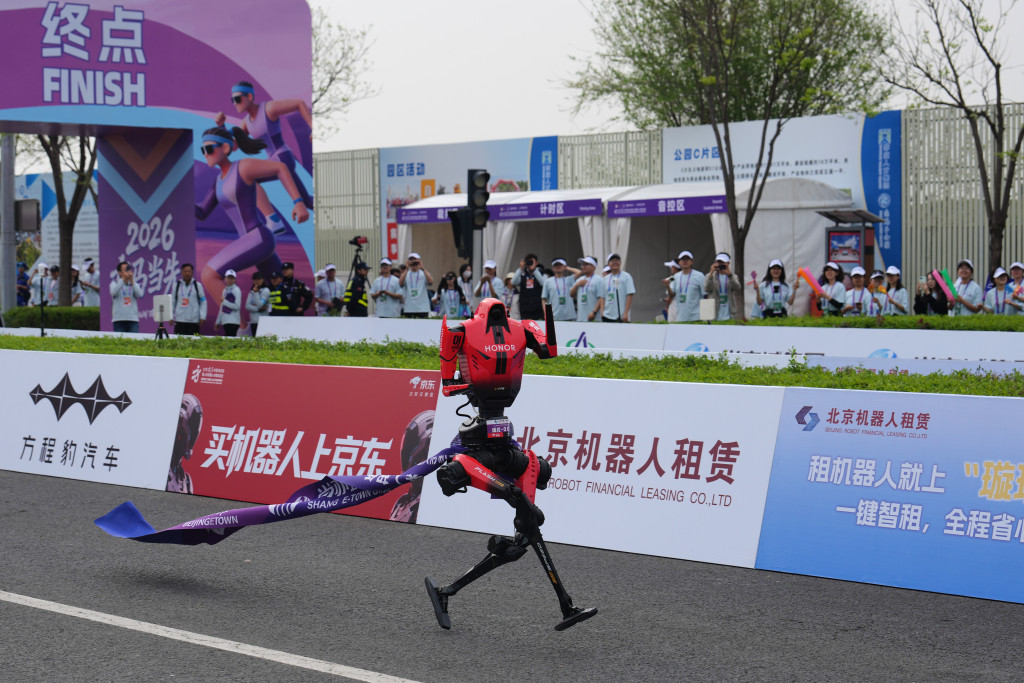
The race included around 20 humanoids competing alongside their human counterparts, with some robots suffering malfunctions or falls, and came just a week before Kenya’s Sabastian Sawe and Ethiopia’s Yomif Kejelcha became the first human athletes to run sub-two-hour marathons in a competitive race at the 2026 TCS London Marathon.
The technology is far more prevalent in China than anywhere else in the world, too. According to the International Federation of Robotics, 470 industrial robots are being operated for every 10,000 workers in the country (compared to a global average of 162), while its robotics market is expected to grow 23 percent annually through 2028, having been valued at an estimated $47 billion in 2024.
Posted in: Esports, Hosts & Suppliers, Latest News, Sites & Venues, Sponsors & Media, Technology in Sports