2026 FIFA World Cup Host City Guide: Houston, Texas
'Space City' will host seven FIFA World Cup matches in 2026, including two knockout round games
Posted On: March 12, 2026 By : Over the course of 11 weeks, SportsTravel is delving into each of the 11 U.S. cities that will host matches at the 2026 FIFA World Cup, which will be the largest edition ever of the event after it was expanded from 32 teams to 48. It will also be the first to be staged in three countries — Canada, Mexico and the United States — and 16 host cities in total.
Up next in our series: Houston, Texas, which will be hosting World Cup matches for the first time. The fourth-most populous U.S. city is a diverse, sprawling metropolis that is recognized globally as “Space City” (due to the presence of NASA’s Johnson Space Center) and as the “Energy Capital of the World” (for its concentration of energy- and gas-related firms). The city also has a rich culture in sports — it has franchises in MLB, MLS, the NBA, NFL and NWSL and has hosted multiple Super Bowls and NCAA men’s basketball Final Fours. Now it will be making its World Cup lift-off in 2026.
[Editor’s Note: Click here to read our past features on Philadelphia, Dallas and Kansas City.]
[For the full list of confirmed base camps so far, click here.]
Stadium
Stadium: NRG Stadium / Houston Stadium
Capacity: 72,000
Opened: 2002
Previous WC Hosting Experience: N/A
Games: Seven matches:
-
Germany v Curaçao | Group E | Sunday, June 14
-
Portugal v Congo DR/Jamaica/New Caledonia | Group K | Wednesday, June 17
-
Netherlands v Albania/Poland/Sweden/Ukraine | Group F | Saturday, June 20
-
Portugal v Uzbekistan | Group K | Tuesday, June 23
-
Cabo Verde v Saudi Arabia | Group Stage | Friday, June 26
-
Match 76 | Round of 32 | Monday, June 29
-
Match 90 | Round of 16 | Saturday, July 4
Location
Completed in 2002 at a cost of $352 million, NRG Stadium (renamed Houston Stadium for the FIFA World Cup) is a retractable roof multi-purpose venue with a capacity of more than 72,000. Home to the Houston Texans starting with their inaugural season of 2002, it was the first NFL facility to have a retractable roof.
NRG Stadium is part of a set of venues known collectively as NRG Park, while the entire complex is named NRG Energy under a 32-year, $300 million naming rights deal signed in 2000.
Designed by HOK Sport, the stadium is situated in the southern part of the city, near the Astrodome — the venue once called “the Eighth Wonder of the World” that served as the home of MLB’s Astros and departed NFL team the Houston Oilers — and approximately seven miles south of downtown Houston.
Team Base Camps
Out of the 42 national teams to have already qualified for the tournament, none has confirmed a team base camp so far in Houston.
Despite that, Houston 2026 World Cup Bid Committee President Chris Canetti said that he was “very, very confident” that one of the last six qualifiers would come to Houston as a base camp, and that the team was hoping to announce that once the play-offs have concluded this month.
Judging by the remaining teams that could still qualify, and the fact that North Texas is already confirmed to be hosting two play-off qualifiers as base camps, that would leave either Italy, Northern Ireland, Wales or Bosnia-Herzegovina, Türkiye, Romania, Slovakia or Kosovo, Iraq, Bolivia or Suriname, or Congo DR, Jamaica or New Caledonia as potential teams that could set up base camps in Houston.
Fan Experience and Activations
It has been confirmed that Houston will have a FIFA Fan Festival and that it will last for 39 days (barring rest days). It will be held in Houston’s East Downtown, also known as EaDo, and it has been described as “the largest and coolest celebration in North America.”
The Festival will broadcast all 104 World Cup matches on large outdoor screens, with more entertainment and cultural offerings being provided.
In addition, the event will take on a space theme to reflect the city’s connection with Space Center Houston, which is the official visitor center of NASA Johnson Space Center. Each day will be uniquely themed to celebrate the diverse cultures of Houston, from live performances to interactive games and global food and drinks, while a rodeo theme is also expected with the Houston Livestock Show and Rodeo on display.
According to Canetti, there is no risk that the FIFA Fan Festival could be canceled or truncated in any way.
“As it pertains to the Fan Festival, we are full speed ahead,” he said. “Our Fan Festival is on track and is not at risk of being cut or reduced in any way. It will be open for all 34 matchdays in the 39-day tournament. We’ll be showing all the games.”
Accommodation Supply
As the fourth biggest city in the United States, Houston has one of the largest hotel and short-term rental inventories in the country.
According to AirDNA, the demand for short-term rentals coincides most notably with matches involving Portugal, Germany and the Netherlands. The games between Portugal and Uzbekistan on June 23 (+273%), Portugal and an Intercontinental Play-off winner (Congo DR, Jamaica or New Caledonia) on June 17 (+266%), Germany and Curaçao on June 14 (+214%) and Netherlands and a UEFA Play-off Path winner (Ukraine, Sweden, Poland or Albania) on June 20 (+178%) are seeing the largest demand growth by match in terms of year-over-year bookings.
The same can be said with occupancy levels, with Netherlands vs Ukraine, Sweden, Poland or Albania (21%), Germany vs Curaçao (17%), Portugal vs Congo DR, Jamaica or New Caledonia (17%) and Portugal vs Uzbekistan (16%) being the greatest drivers in occupancy growth so far.
Across the Houston group stage dates, the average available nightly rate currently sits at $326, compared to $177 at the same time last year — representing an 84% increase from 2025 levels.
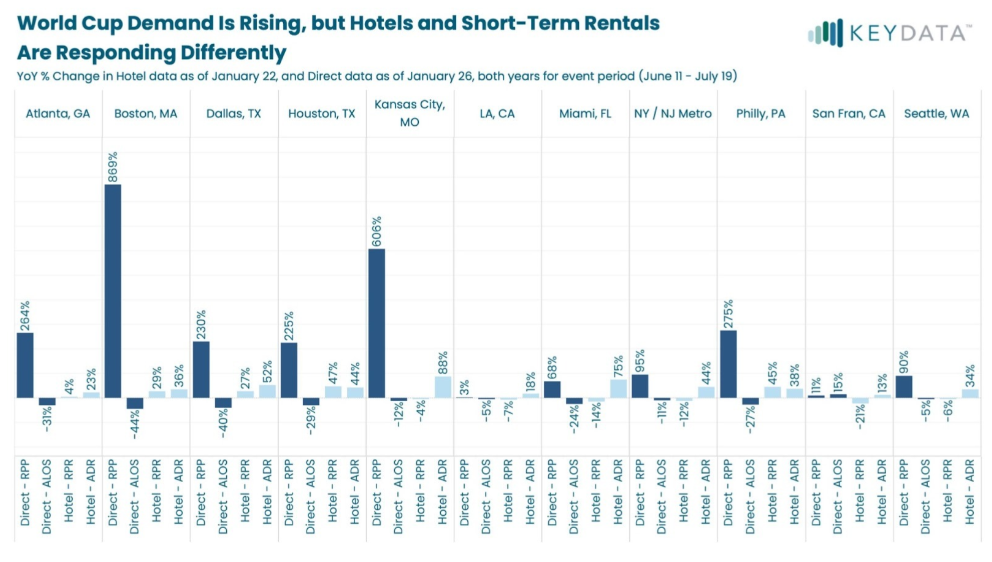
The chart produced by Key Data above demonstrates that Houston is seeing one of the largest increases in short-term rental reservations per property (+225%) during the World Cup of the 11 U.S. host cities, and not surprisingly, length of stay drops sharply as fans move on to other cities or head home after games. On the hotel side, reservations per room and average daily rates are rising at relatively healthy levels, at 47% and 44% respectively.
Meanwhile, according to CoStar forecasts, the average daily rate in Houston at the time of the FIFA World Cup is one of the lowest of the 11 U.S. host cities at $136.24. However, this would also be the fourth largest year-on-year growths from 2025, at +0.119%, with the city due to host a strong contingent of seven matches.
Q&A: Chris Canetti
What does it mean to you to bring the FIFA World Cup to Houston?
It’s extremely exciting for me personally. I’ve worked in soccer here in the United States since 2000, spending 19 years in Major League Soccer between Houston (Dynamo) and New York (Red Bulls) and I’ve worked on this World Cup project for nearly seven years now. We started back in 2019 when we were bidding to be a WC host city so to be under 100 days from the event, it’s very exciting for everyone around the city. On one hand, I wish time would slow down and we’d have a bit more time to prepare, but on the other, I can’t wait for it to get here.
Tell us about your legacy initiative in Houston and its goals.
It’s called FREEKICKS Soccer. When we were a prospective host city bidding to host the World Cup, we wanted to put forward some aggressive grow-the-game initiatives around legacy. We put together a sub-committee and we explored issues and opportunities around the Houston market. Our committee identified that one of the biggest challenges we’re facing here is a lack of access to the game for underserved youth. Soccer is a pay-to-play sport in the States — it’s very organized, it’s very costly and most of the youth clubs are out in the suburbs where there are beautiful soccer pitches and everything you need — but these underserved communities don’t have this same level of access.
We announced our intentions back in 2019 to create FREEKICKS Soccer around a friendly match between Bayern Munich and Real Madrid and here we are seven years later — it’s come to fruition and it’s actually happening. To bridge this gap, we worked with our community leaders to either build or renovate 23 full-sized pitches in our underserved areas. We are now upgrading and improving these pitches as great places for kids to play, and the next part of the equation is ensuring that soccer actually occurs there. We’ve also worked with five local area youth soccer clubs who will now be operating out of these 23 pitches and bringing organized youth soccer to these neighborhoods, and at the same time, they will be investing $1.5 million annually into coaching and infrastructure, as well as providing 1,000-plus scholarship opportunities.
It’s an ambitious plan and we’re proud of what we’ve accomplished with so many different people involved. We wouldn’t have been able to accomplish this without the World Cup being here as it encouraged us to think big and this will be our primary legacy for years and years to come.
What other opportunities can the World Cup bring and what are your motivations?
We saw people were doing things to bring soccer to underserved communities but they were in the form of clinics or camps, after-school programs or clubs. We thought it was very important to create an equitable playing experience for kids where it wasn’t just a camp for a week. We wanted them to play the full-on club experience where you’re on a team, you wear the colors, you practice two/three times a week, you play on a weekend, you win or lose, and you play the whole thing.
What logistical or operational challenges do you still have to negotiate before the start of the tournament?
The beauty of this program is that our local government has taken the lead in funding the refurbishment or construction of these fields. That will not be immediate, it will be a phased process and it’s ongoing. We’re working with our leadership on all of those improvements. These clubs know what they’re doing as businesses so they will be setting up operations and it’s their obligation and responsibility to do everything. As a host committee, we have been the visionary for this and we have put all the pieces together, but we’re not capable of managing this so we brought in the experts who can do this long term.
As a Host Committee, we go away in a year’s time right after the World Cup so we want to hand this off to our community leaders and youth soccer clubs to manage this well into the future.
What kind of welcome can fans expect when they attend matches?
Most people might not realize Houston is the fourth largest city here in the United States. We have a lot of folks from the UK here because of the oil and gas presence in the city. It’s a very welcoming and international city — one of the most diverse and international communities in North America.
While we love American football here, there is a great culture for international soccer. We have seven matches here in Houston and we’re featuring three of the top 10 teams in the world in Germany, the Netherlands and Portugal (twice), plus we have two knockout games.
There will be lots of cool activations and fun games so we’re really excited about this. We see this as a moment in time to showcase our city and let the world know that Houston is a great place and the WC presents that opportunity for us.
More Local Reaction
Hussain Naqi, general manager at NRG Park: “Hosting matches for the 2026 FIFA World Cup at NRG Stadium is an incredible honor for Houston, Harris County, and for everyone at NRG Park. This venue has welcomed some of the biggest sporting events and entertainment spectacles in the world, and the World Cup represents the ultimate global stage. We’re excited to showcase Houston’s energy, diversity and hospitality to fans from across the globe and deliver an unforgettable experience for everyone who walks through our doors.”
Martye Kendrick, CEO and executive director of Harris County Sports & Convention Corporation:“The FIFA World Cup coming to Houston and Harris County is more than just a series of matches, it’s an opportunity to welcome the world to our community. Hosting the World Cup will unite fans, energize our local economy and create lasting memories for residents and visitors alike while showcasing Houston and Harris County as a premier international sports destination.”
Michael Heckman, president and CEO of Houston First Corporation: “Serving as a host city for the FIFA World Cup is about both short- and long-term impact, and it’s incumbent on us and our partner organizations to maximize the potential of each. We recently deployed a new marketing campaign dubbed World in a City—with dozens of assets highlighting the many cultures and communities that make Houston unique. The assets of the campaign are also being shared with our stakeholders so they can use them in their marketing as part of an ongoing, collaborative initiative that will live on well past World Cup and drive more visitation and spending to Houston.”
Posted in: 2026 FIFA World Cup, Feature Story, Latest News, SportsTravel Archives