2026 FIFA World Cup Host City Guide: Kansas City, Missouri
Kicking off our guide to the 11 U.S. host cities with a soccer hotbed in the American heartland
Posted On: March 9, 2026 By : Over the next 11 weeks, SportsTravel will delve into each of the 11 U.S. cities that will host matches at the 2026 FIFA World Cup, which will be the largest edition ever of the event after it was expanded from 32 teams to 48. It will also be the first to be staged in three countries — Canada, Mexico and the United States — and 16 host cities in total.
First up: Kansas City, Missouri, which will be hosting World Cup matches for the first time. That speaks to the region’s growing impact in the soccer world, which includes having Sporting KC as a founding member of Major League Soccer on the men’s side and CPKC Stadium, home of the NWSL’s Kansas City Current, the first venue built specifically for a women’s pro soccer team in the United States.
[Editor’s Note: Click here to read our past features on Philadelphia, Dallas and Houston]
[For the full list of confirmed base camps so far, click here.]
Stadium
Stadium: Arrowhead Stadium / Kansas City Stadium
Capacity: 73,000
Opened: 1972
Previous WC Hosting Experience: N/A
Games: Six matches:
-
Argentina v Algeria | Group J | Tuesday, June 16
-
Ecuador v Curaçao | Group E | Saturday, June 20
-
Tunisia v Netherlands | Group F | Thursday, June 25
-
Algeria v Austria | Group J | Saturday, June 27
-
Match 87 | Round of 32 | Friday, July 3
-
Match 100 | Quarter-final | Saturday, July 11
Known as Arrowhead Stadium for decades and the home of the NFL’s most recent dynasty in the Kansas City Chiefs, the venue is being renamed “Kansas City Stadium” for World Cup matches because of FIFA’s marketing rules. This will be the venue’s one chance to host matches on soccer’s biggest stage: the Chiefs have announced plans to move across the nearby state line and call Kansas home starting in 2031.
Location
For those unfamiliar with Kansas City, the city is located on the western border of Missouri. Just on the other side of that border is Kansas City, Kansas, a separate city that combines with its bigger namesake to make up the Kansas City Metropolitan Area. Arrowhead Stadium / Kansas City Stadium is located in Kansas City, Missouri. The Missouri city is the 38th-most populous in the country at 508,090 according to the 2020 census, while the city with the same name in Kansas has a population of roughly 156,000. The larger metro area is the 31st-most populous in the nation at 2.25 million residents.
Team Base Camps
Four qualified national teams have so far announced team base camp training sites in the greater Kansas City region, across both Kansas and Missouri.
Reigning champions Argentina will set up at Compass Minerals National Performance Center, the training facility for Major League Soccer’s Sporting Kansas City in Kansas City, Kansas.
England, which last won the World Cup in 1966, is set to train at Swope Soccer Village, one of the training facilities of Sporting Kansas City in Missouri, and will stay at four-star boutique hotel The Inn at Meadowbrook.
The Netherlands will utilize the KC Current Training Facility in Missouri, which is also the training complex of the Kansas City Current.
Algeria will train at the University of Kansas’ Rock Chalk Park in Lawrence, Kansas, and is expected to stay at the four-star Oread Hotel on 1200 Oread Ave.
Fan Experience and Activations
Visit Kansas City is providing everything from travel basics to hotel / restaurant recommendations, pre-built itineraries for sightseeing and more at its website.
KC2026 is the nonprofit organization overseeing strategy and delivering host city duties for the 2026 FIFA World Cup. The organization has put together a transportation plan to explain how fans will be able to get from Kansas City International Airport in Kansas City, Missouri, to downtown, to the Fan Festivals, to the stadium and more.
Kansas City’s Official FIFA Fan Festival is set to be open for 18 days throughout the tournament and is free for all fans to attend. It will take place on the grounds of the National WWI Museum and the Liberty Memorial, which celebrates its centennial in 2026.
Accommodation Supply
Kansas City has less than half the available hotel and short-term rental inventory of major markets like Los Angeles or Miami. That relative constraint is likely contributing to early occupancy surges and a sharp increase in asking available rates.
According to business intelligence data platform AirDNA, Kansas City is seeing the strongest year-over-year increase in short-term rental (STR) bookings among the U.S. host cities so far, followed by Dallas-Fort Worth and Houston, Texas. In terms of stay patterns, 42% of World Cup reservations in Kansas City are for one to two nights, and 35% are for three to four nights.
The match with the most STR bookings so far is Tunisia vs. Netherlands on June 25, with occupancy already at 47%, followed by Argentina vs. Algeria on June 16 at 44%. Meanwhile, on pricing, the average booked rate across group stage dates is currently $281, up 20% year-over-year, as hosts anticipate strong international demand.
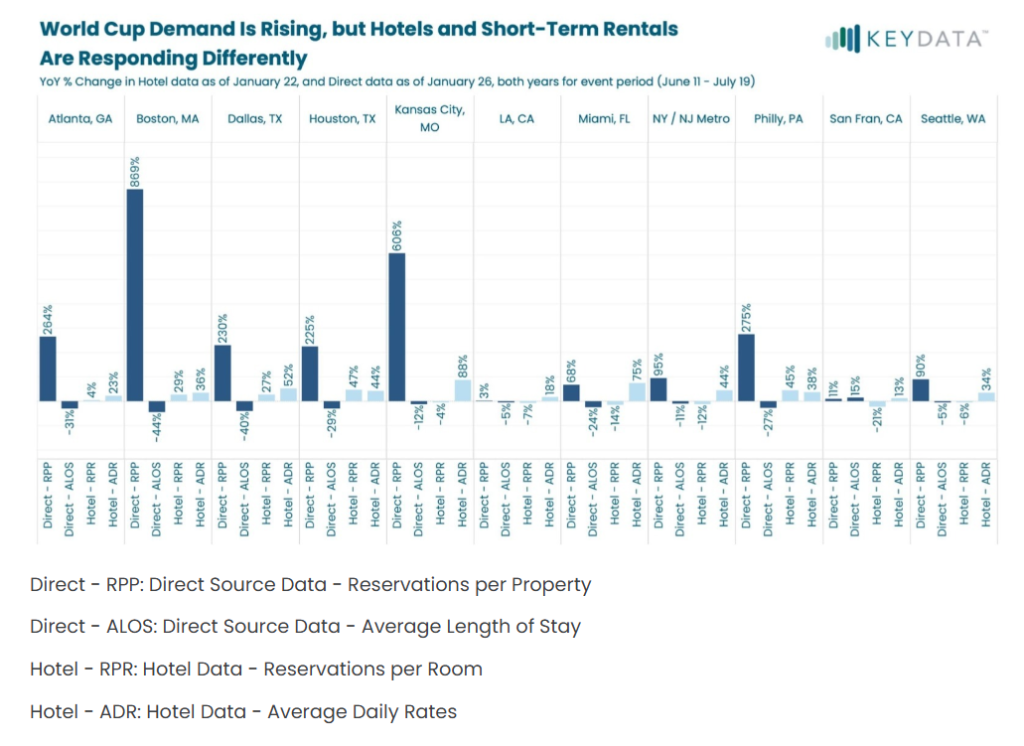
World Cup demand is being absorbed differently across lodging types in host and adjacent markets, according to hospitality data provider Key Data.
On the hotel side, booked rates are rising sharply in most markets, even where guest check-ins are flat or declining, signaling strong pricing power and early capture of short, event-driven stays.
Short-term rentals, by contrast, are seeing significant increases in bookings per property in several markets, but those gains are often accompanied by declining average length of stay, reflecting a shift toward shorter, match-focused trips. As the image below shows, Kansas City is seeing the second largest year-on-year increase in reservations per property (606% growth) and the largest YoY increase in average daily rates among all 11 U.S. host cities.
Together, these trends suggest that demand is not concentrating in a single segment, but instead fragmenting based on traveler needs and lodging flexibility.
Q&A: Pam Kramer, KC2026 CEO
What does it mean to you and Kansas City to be hosting the FIFA World Cup?
Kansas City may be the smallest U.S. host city but we sit at the heart of the country — and we intend to show the world what that means. For us, hosting the FIFA World Cup 2026 isn’t just about matches — it’s about creating a sense of belonging for locals in the region and everyone who will visit here. It’s about a global event choosing a city that believes deeply in sport as a unifier and a source of pride.
This is a generational moment for our region. We have a long history of showing up for soccer — from youth leagues to sold-out stadiums — and now we get to welcome the world onto our home pitch. What excites me most is that visitors will experience Kansas City the way we know it: welcoming, unpretentious, passionate and deeply connected to one another.
What are the major opportunities the tournament will bring?
At its core, this tournament is about connection. The World Cup will bring global attention to our region, and that kind of spotlight creates enormous opportunity–economically and culturally.
Yes, the impact for local businesses will be significant. But what matters just as much is how prepared and confident our business community feels when the world arrives. Through KC Game Plan, we’re giving businesses practical tools, training sessions and a comprehensive playbook so they’re not just reacting — they’re ready. Ready to welcome new customers. Ready to share their story. Ready to reflect the hospitality that defines the Midwest.
We want every restaurant owner, shopkeeper and hotel manager to feel like they are part of this moment—because they are. The World Cup experience won’t just happen inside the stadium. It will happen across storefronts and neighborhoods throughout our region.
What are some of the logistical / operational challenges that have to be negotiated before and during the tournament?
What makes us unique is that we are truly a bi-state region. Our planning and support spans numerous jurisdictions across Kansas and Missouri, and that requires deep coordination among civic, business and government leaders at every level.
The complexity is real, but it’s also one of our strengths. We’re accustomed to working across the state line. Our infrastructure, our business community and our leadership already operate as one region. For the World Cup, that mindset becomes even more important as we coordinate transportation, safety and security, fan movement and experience, and regional communications.
Our goal is to make it feel seamless for visitors. Fans shouldn’t have to think about which state they’re in. They should simply feel that Kansas City is easy to navigate, easy to enjoy and unified in delivering a world class experience.
What kind of welcome can fans expect when they attend World Cup matches in your city?
Fans can expect an experience that feels simultaneously global and distinctly Kansas City. The heart of that celebration will be the FIFA Fan Festival at The National WWI Museum and Memorial, one of the most iconic sites in our region. It’s a powerful setting for a global gathering, and it reflects our belief that sport can bring diverse people together in meaningful ways.
FIFA Fan Festival is free to attend and will be open at least 18 days in June and July with a wide range of themed programming. Whether you’re a lifelong soccer fan or just want to be part of history, there will be a place for you here. That sense of inclusion is very intentional.
On days when the FIFA Fan Festival is not open, we encourage visitors to explore Kansas City to join watch parties and community events taking place across the region. People will discover authentic experiences wherever they venture. Ultimately, fans should feel welcomed and like they’re a part of something bigger than themselves. That’s what Kansas City does well. We make people feel like they belong.
More Local Reaction
“Kansas City is thrilled to welcome the world, hosting six FIFA World Cup matches and becoming a home away from home for four impressive teams,” said Kathy Nelson, president and CEO of Visit KC and the Kansas City Sports Commission. “As the Soccer Capital of America, Kansas City is a sports fan’s paradise, and there’s so much more to explore beyond the pitch. We’re excited to showcase our diverse food, music, art and cultural experiences as our city steps onto the global stage.”
“We can’t wait to welcome the world to Kansas City and deliver an exceptional experience for the hundreds of thousands of visitors who will travel to our region,” said Sporting Kansas City President and CEO Jake Reid. “The local excitement and global visibility generated by this month’s team base camps announcements showcase just what an incredible event this is going to be this summer.
“Hosting FIFA World Cup matches will bring significant long-term benefits — including jobs, economic activity and global visibility – to our region and has the potential to further strengthen Kansas City’s future growth. This is a tremendous opportunity to showcase our world-class city, facilities and hospitality to an international audience for tourism, talent recruitment and business development.”
Posted in: 2026 FIFA World Cup, Feature Story, Hosts & Suppliers, Latest News, Sites & Venues, Soccer, Sponsors & Media, Sports Organizations, Sports Venues