

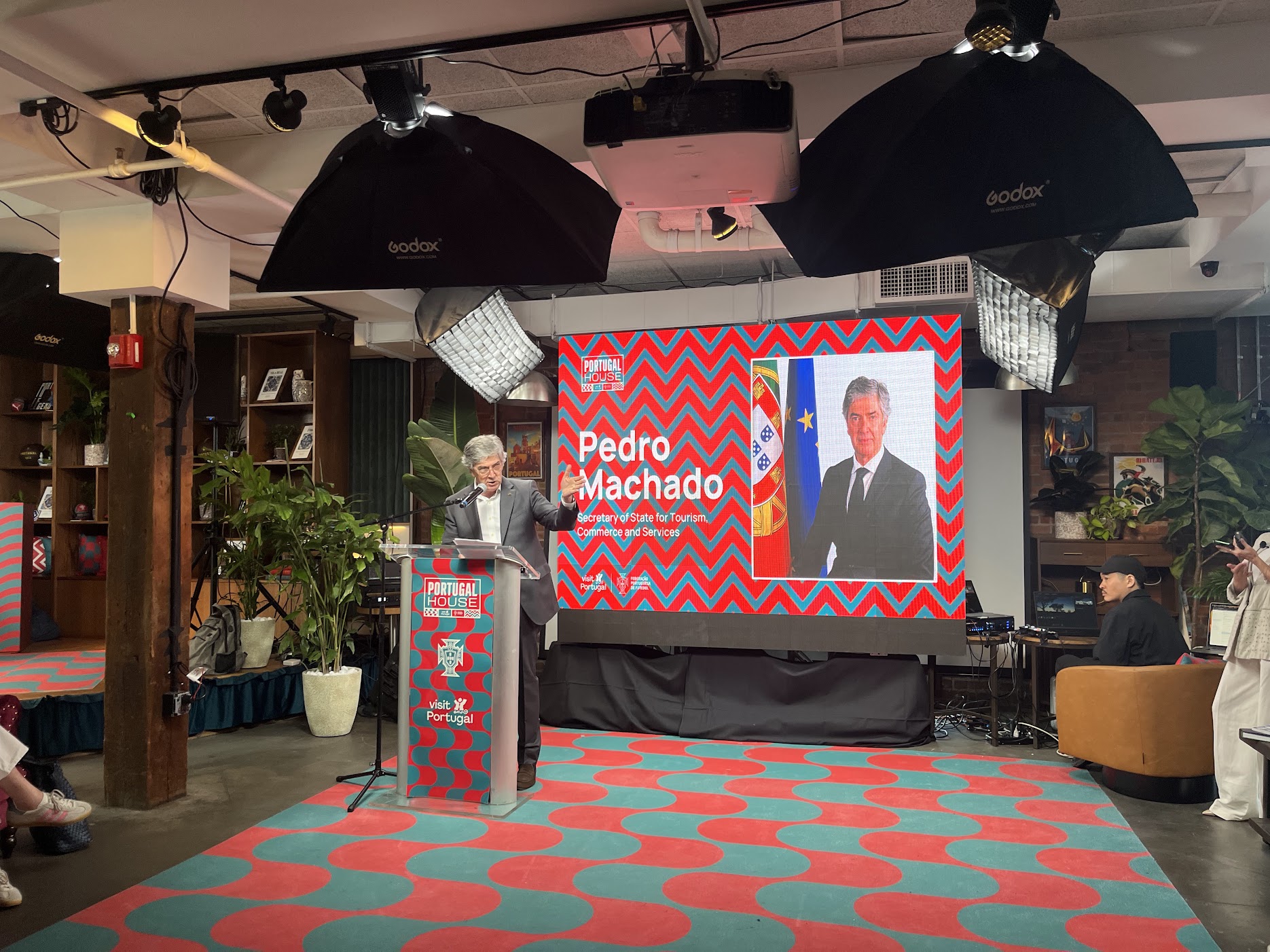
With the 2026 FIFA World Cup drawing global attention to North America, Portugal is using the moment to make its case to U.S. organizers and visitors. The country will share 2030 World Cup hosting duties with Spain and Morocco, and on June 26, the Portuguese Football Federation is hosting Portugal Football Summit Miami — the first edition held outside Portugal. It’s one piece of a broader U.S. activation program, which also includes Portugal House, a hub of cultural experiences, live music, gastronomic programs and screenings of every match in this year’s World Cup, running over 40 days at Time Out Market in Brooklyn, New York.
SportsTravel visited Portugal House and spoke with Portugal Secretary of State for Tourism, Commerce, and Services Pedro Machado. He argued that the infrastructure and venue options currently available or expected to roll out in the near future make Portugal an ideal host country, not only for the World Cup but for a wide range of other world-class sports events. He discussed what’s already in place, what’s soon to come, and where the opportunities for U.S. rights holders lie.
SportsTravel: Tell us about Portugal’s current pitch to the U.S. market, and why the 2026 World Cup is a good time for event organizers and potential visitors to be thinking about Portugal?
Pedro Machado: The American market is very important for us. In 2025, we received about 2.3 million Americans in Portugal, spending about 3.4 billion Euros, which is very strong for our economy. Now we have the FIFA World Cup. Portugal is a strong candidate, and we have this ambition to feel it for the first time in Portugal. And we have this partnership with the Portuguese Federation of Football and Portugal House here at Time Out Market. The world is focusing on the FIFA World Cup, so this is very important and a big, big opportunity to say Portugal wants to receive more American people. They are very, very important for us, for our economy.
SportsTravel: With Portugal co-hosting the 2030 FIFA World Cup, how are you using that as an opportunity to attract more international sports events before and after the tournament?
Pedro Machado: We are hosting the championship in 2030, but this is not only about the football. Portugal is now positioned to get the biggest-footprint sporting events in the world. We have, in ’27 and ’28, the F1 in Portugal, in Algarve. We just finished the contract for the Ocean Race in 2027. We have the MotoGP, the Grand Prix. We have the WSL — then World Surf League’s Rip Curl Pro Portugal in Peniche [the Supertubos of Peniche is one of the most important and best-known waves in the world for surf]. We start the PGA Tour for Legends with Ernie Els, Tiger Woods, some American players. They go to Algarve, and they start July 28.
SportsTravel: What investments in venues, transportation and visitor infrastructure are being made ahead of 2030 — and how can those benefit future event organizers?
Pedro Machado: For 2030 maybe the most important thing for us is the new airport. We have five airports in Portugal: Porto, Lisbon, the Algarve, Azores and Madeira. But we received 32 million foreign tourists in 2026 in Lisbon. So now we are working to build a new airport.
We have also invested in trains. We have a very good train connectivity with Portugal because our principal markets now, even in tourism, are the United Kingdom, France, Italy and Spain — they are very important for us. We have three big stadiums, we have the Algarve, we have hotels, we have very good infrastructure so that we can gain these big events. And the north is growing too — Porto is also a very nice region, and next week it will be hosting the Air Invictus air show.
SportsTravel: As destinations compete to host major events, what makes Portugal stand out as a sports-event destination?
Pedro Machado: We are a small country — between the north and the south, more or less 800 kilometers. In 800 kilometers, you have five different regions: In the north, we have the mountains, we have the wine, we have the monuments. In the south, we have the beach. Algarve was named, in the last years, the best destination for beaches in the world — several times. Lisbon was named the best for cities in the world, twice.
We have, more or less, 20 places in Portugal with UNESCO heritage. Now, we have 44 restaurants with one-star Michelin, and nine restaurants with two stars.
SportsTravel: Concerns have been raised about the cost of entry for the World Cup here in North America, with high ticket prices, hotel rates and transportation costs. Are you concerned about cost being a potential issue in Portugal that might prevent visitors from wanting to attend?
Pedro Machado: Portugal is not an expensive destination. In New York, a glass of wine costs, what? $20? $24? With $20, you can have an entire special bottle of wine in Portugal — of good quality. And that’s the same across the gastronomy, the restaurants, the hotels, the transportation, aviation. We are not a very expensive country.
Our prices are like our climate: We have a moderate climate all year. We don’t have it too hot and too cold. We are just right.
SportsTravel: What opportunities do you see for stronger partnerships between Portugal and U.S.-based sports event organizers and rights holders?
Pedro Machado: The American market is very important for us. In 2025, it was one of our principal source markets, and it’s growing. Americans passed the Brazilians in terms of visitors to Portugal. In the case of the United States, we have 152 direct flights by week to Portugal, by United, by Delta Airlines, TAP and SATA from Azores Airlines. So we are a very connected country.
And did you know our history together goes back to your founding? The Founding Fathers drank wine from our island of Madeira at George Washington’s inauguration.










 Copyright © 2026 by Northstar Travel Media LLC. All Rights Reserved. 301 Route 17 N, Suite 1150, Rutherford, NJ 07070 USA | Telephone: (201) 902-2000