

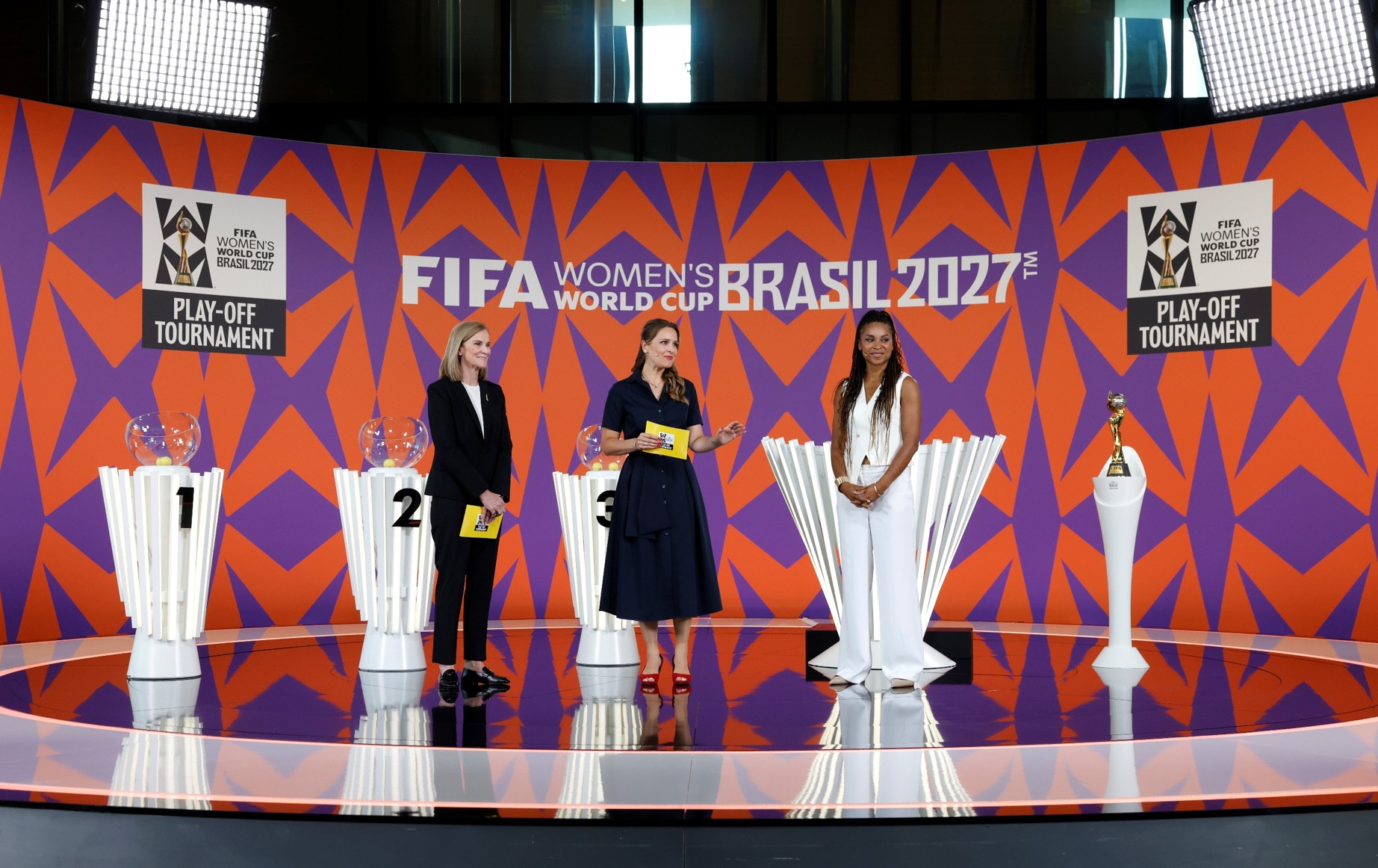
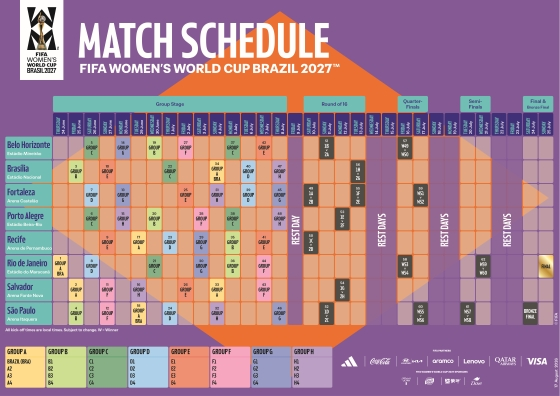
One month after the conclusion of the 2026 FIFA Men’s World Cup in Canada, Mexico, and the United States, FIFA on Thursday unveiled the full match schedule for the 2027 FIFA Women’s World Cup in Brazil.
The announcement was made at FIFA’s headquarters in Zurich, Switzerland, during the draw show for the preliminary phase of the 2027 FIFA Women’s World Cup Play-Off Tournament. It confirms where all 64 matches will be played across Brazil’s eight host cities: Rio de Janeiro, São Paulo, Brasília, Porto Alegre, Recife, Belo Horizonte, Fortaleza, and Salvador. This is the first time in the event’s 10 editions that it will be held in South America.
The championship match will be held at Estádio do Maracanã in Rio de Janeiro on July 25, 2027.
Host nation Brazil will begin its campaign for its first Women’s World Cup title at the Estádio do Maracanã in Rio de Janeiro on June 24, 2027. It will then play its two other group-stage matches at Arena Itaquera in São Paulo on 29 June, and at the Estádio Nacional in the capital city of Brasília on July 4, respectively.
All eight host cities will stage at least seven matches, including a minimum of one knockout fixture, and were all previously host cities at the 2014 FIFA Men’s World Cup in the same country.
‘Goosebumps’
“We can’t wait to witness a new chapter of women’s football history unfold when the world’s best players, coaches, fans and local communities take centre stage in Brazil next year,” said FIFA President Gianni Infantino. “I already have goosebumps thinking about the incredible passion, colour and energy that Brazilian fans will bring to the tournament as they welcome the world to eight vibrant host cities.”
The Estádio do Maracanã hosted the men’s World Cup final in 2014 and will become only the third stadium to host finals in both the men’s and women’s World Cups. It will join the now-demolished Råsunda Stadium in Solna, Sweden (1958 and 1995), and the Rose Bowl in Pasadena, California in the United States (1994 and 1999), in achieving the feat.
“As we developed the match schedule, we carefully balanced sporting fairness across all 32 teams, considering travel distances, recovery time between matches, and the overall competition experience,” added Dame Sarai Bareman, FIFA’s chief women’s football officer. “At the same time, we wanted to ensure fans across Brazil could be part of the excitement and that each host city could play its role in this celebration of women’s football. We are especially excited that the tournament will begin at the iconic Estádio do Maracanã, setting the stage for what promises to be an epic FIFA Women’s World Cup.”
Competing Nations
The tournament will feature 32 nations for the second time, with six direct slots for AFC (Asia), four direct slots each for CAF (Africa) and Concacaf (North and Central America), four direct slots for CONMEBOL (South America), one direct slot for OFC (Oceania), and 11 direct slots for UEFA (Europe).
As the host country, Brazil is already confirmed as an automatic qualifier. So far, 17 other countries have secured a spot in the tournament: Algeria, Argentina, Australia, Cameroon, China, Colombia, Denmark, France, Germany, Japan, Malawi, Morocco, New Zealand, North Korea, Philippines, South Korea, and Spain.
The final three teams to qualify will be decided via the Play-Off Tournament, which will be staged in a centralized location in February 2027. Two teams among Chinese Taipei, South Africa, Ghana, Uzbekistan, Papua New Guinea, and Ecuador will progress from a preliminary league phase of the tournament (to be played in November and December 2026) to the final play-off round.
The United States, which has won a record four Women’s World Cups, has not yet qualified but can do so this fall via the Concacaf W Championship in Texas. All the semifinalists of that eight-team event are ensured a spot in the Women’s World Cup.
Spain is the reigning champion, having defeated England 1-0 in the 2023 finals, hosted by Australia and New Zealand, to win its first Women’s World Cup title.
It will also be the final edition of the FIFA Women’s World Cup to feature 32 teams, before it expands to 48 teams in 2031. That edition will be hosted by the United States, Mexico, Costa Rica, and Jamaica, and will adopt the same 12-group format as the 2026 FIFA Men’s World Cup.
Base Camps
In April, FIFA published the first official version of the Team Base Camp brochure for the 32 national teams that will qualify for the competition.
The first version of the brochure, which has been shared with all Member Associations still in contention to qualify for next year’s tournament, features 38 training sites across Brazil, and all have been paired with accommodation facilities.
Final Draw and Tickets
The Final Draw for the 2027 FIFA Women’s World Cup will take place later this year in Brazil, likely in December 2026. More details will be announced closer to that time, alongside the publication of the next version of the match schedule.
Fans can register their interest in tickets now for the tournament at this link.
FIFA Controversy
British newspaper The Times reported on July 28 that FIFA was exploring a new structure that would allow it to sell stakes in its prime assets (including media contracts, sponsorships, events) to private investors, and the story led to a swift and harsh rebuke from the soccer community. UEFA (Europe), Asian Football Confederation (Asia), and Concacaf (North and Central America, and the Caribbean) all voted against the proposals and pushed for indefinite boycotts of FIFA events/competitions.
On August 1, Infantino abandoned his sell-off plans after his private investors backed out, and now his own tenure as head of the international federation is being called into question.
FIFA Senior Advisor Carlos Cordeiro (a former president of the United States Soccer Federation) resigned from his position in a rejection of Infantino’s proposals, while Chief Operating Officer Kevin Lamour, who had spoken out publicly about feeling “deceived” by the plans, was later fired by the President.
Infantino’s position will likely be challenged in the next presidential election at the 77th FIFA Congress in Morocco next March, with Canada’s Victor Montagliani a potential rival.
Meanwhile, UEFA and its 55 member associations pledged to boycott all FIFA events/tournaments if the plans proceeded and/or if Infantino did not resign.
That would put severe pressure on the organization of the 2027 FIFA Women’s World Cup, as well as future FIFA tournaments.










 Copyright © 2026 by Northstar Travel Media LLC. All Rights Reserved. 301 Route 17 N, Suite 1150, Rutherford, NJ 07070 USA | Telephone: (201) 902-2000