A Beginner’s Guide to Visiting Wimbledon 2026
How to get tickets and what to expect once you step inside the All England Lawn Tennis Club
Posted On: July 7, 2026 By :“You never forget your first time on Centre Court.”
That’s what I was told before I set foot last week in the storied stands of Wimbledon’s centrepiece arena, probably the most famous tennis stadium in the world.
The oldest of the four tennis Grand Slams and the only one to be played on grass, The Championships, Wimbledon, is on the verge of its 150th anniversary next year, and while its iconic traditions remain, the event continues to innovate with the times and attract new waves of fans to its iconic grounds in South London.
Although I had previously visited the Championships once by queuing for five(!) hours, this was my first experience of Centre Court during competition alongside my brother, David, as well as our first time being successful in the Public Ballot. Although the All England Lawn Tennis Club (AELTC) does not publicly disclose exact applicant figures each year, it is estimated that millions of people apply annually, and because the event is oversubscribed, the odds of drawing a ticket could be as low as one in 10.
For those who might one day find themselves at Wimbledon for the first time, here is your beginner’s guide to a visit to SW19:
Options to Attend
There are multiple ways to attend Wimbledon, depending on how much you are prepared to pay, which matches you want to watch, and how long you are willing to wait.
The official Public Ballot allows tennis enthusiasts to apply in advance for an opportunity to win tickets to any of the Show Courts (Centre, Number One and Number Two Courts) each year. Anyone can enter by creating a myWimbledon account during the Public Ballot open dates (September 2 through September 21, 2025, for the 2026 Championships), although you can only submit one application per household and you cannot request tickets for specific days, courts or seats.
The Queue is a true Wimbledon staple dating back to 1927, when some 2,000 people were turned away at the gates because the grounds were at capacity. Visitors can join the Queue up to a day before entering the grounds by arriving from Wimbledon Park (and via Southfields Tube Station), and the most dedicated will bring sleeping bags and tents to queue overnight. A limited number of Show Court and Grounds Pass tickets will be sold individually each day, however, fans are arriving incrementally earlier each year (10,000 fans were queuing by 08:30 on the opening day of the 2026 Championships).

Fans may also decide to opt for official hospitality packages via Keith Prowse, the sports and events hospitality company that serves as Wimbledon’s official hospitality partner, guaranteeing seats with fine dining or VIP experiences. Packages like these secure seats on either Centre or Number One Court, and will set you back at least £1,100 per person ($1,472).
Otherwise, fans can either access premium Debenture tickets — the only Wimbledon tickets legally permitted to be purchased and sold on the open market — or Online Resale tickets that are returned by Public Ballot ticket holders and are released virtually across Wimbledon’s channels (sometimes costing £10-£15 after 3pm).
Fans should also check out the Wimbledon ground rules before visiting to see what they are allowed to bring with them, as the venue is fully cashless and alcohol supplies are strictly regulated.
Atmosphere
It is a natural stereotype that the British crowds are heavily supportive of home players, but they are respectful to opponents from other countries and are not quite as partisan as some fanbases at other Grand Slam tournaments. This, in turn, creates a level of respect between the players and the crowds in on-court interviews after matches, as the players appreciate the support in both camps.
What also makes the atmosphere so special at Wimbledon is the pockets of fans from different countries supporting their tennis idols. Roger Federer had his “FedFans,” Novak Djokovic has his own “NoleFam” fan base, and Coco Gauff has her affectionate group of “CocoNuts,” for example. These fans can travel to all corners of the globe to support one player, whether they are in pairs or larger legions of fans combining with friends and families.
While I was at the Championships last week, I spoke to two ladies who had come all the way from Quebec in Canada, not to support a particular athlete, but because Wimbledon is an annual routine in their calendar. Behind us was a group of Spanish fans, and in front of us was an especially vociferous set of Italian supporters chanting in support of World Number One Jannik Sinner, all fully invested in the matches.

It is not uncommon to hear individuals start up spontaneous chants or the sound of champagne corks popping in the stands in breaks between games or sets. However, doing these during play or making other loud, disruptive noises is seriously bad etiquette and will at least result in attracting the disdain of other spectators around you.
Traditions
Wimbledon is synonymous with rules and traditions, setting it apart in terms of prestige from the other major tournaments throughout the year.
On the players’ side, they are all required to wear white, as per AELTC rules. This applies to all visible clothing, with only small sponsor logos in color allowed as exceptions, and it is believed that the white rule was initially created as a way of hiding players’ perspiration as much as possible.
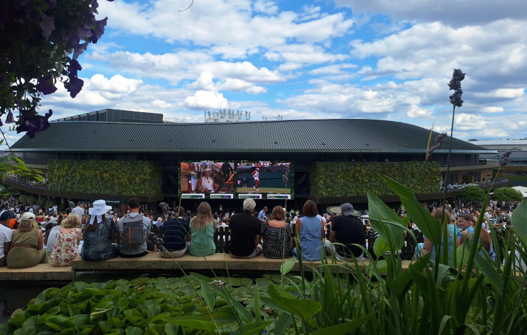
If you’re a first-time visitor, you will certainly want to head to Henman Hill (named after former British Number One and Wimbledon semi-finalist Tim Henman) to get the best views of the grounds and watch the top matches on the big screen provided. The Hill’s name has taken on several iterations in recent years e.g. “Murray Mount” for Andy Murray and “Arthur’s Seat” after rising star Arthur Fery), but the story of its actual name has a fascinating background. “Aorangi Terrace,” as it is formally known, is named after the highest peak in New Zealand (Aoraki or Mount Cook), after the AELTC leased the land for the grassy slope and practice courts to the London New Zealand Rugby Football Club and the New Zealand Sports and Social Club in 1967.
And of course, no visit to The Championships would be complete without savoring the traditional food and beverage offering, most notably strawberries and cream. Did you know that, on average, around 28,000 kilograms of strawberries and 7,000 litres of cream are consumed each year at Wimbledon? The tradition reportedly dates back to the early days of the competition in the Victorian era.

Former Champions Take the Limelight
On Day Three of the Championships on Centre Court, my brother and I were fortunate enough to watch three matches and witness four Grand Slam champions — reigning Men’s Wimbledon champion Jannik Sinner, seven-time Wimbledon champion Novak Djokovic, former Wimbledon Ladies’ champion Barbora Krejcikova and reigning French Open champion Mirra Andreeva.
Despite the possibility of having to play five sets in a Grand Slam, Sinner and Djokovic both advanced smoothly in three sets past Nuno Borges and Stefanos Tsitsipas, respectively, while Krejcikova came from a set down to usurp Andreeva in front of a rapturous crowd.
One element that the players always cite in interviews and press conferences is the aura of Centre Court, and you can feel it too as a spectator. Many great champions have graced the lawns of this famous court over the years, and the noise generated by the fans only adds to the sense of legacy and occasion.
Wimbledon was not always this glamorous. Back in the first year of the Championships, 22 players had to pay one guinea to play, which would translate to around £160 in today’s money, or $214.
Nowadays, the competitors can earn into the multimillions from progress at the tournament and from lucrative sponsorships. The total Wimbledon prize pot now stands at £64.2 million (Gentlemen’s and Ladies’ singles champions earning a record £3.6 million payout each) — a 20 percent rise from £53.5 million in 2025 — although players still threatened to protest that they were not earning enough when this only equated to 15 percent of Wimbledon’s total annual revenues.
Innovations and Activations
In the lead-up to the tournament, the AELTC worked closely with official partner IBM to launch new and enhanced digital fan features across the Wimbledon app and website. Both were modernized and redesigned with AI-powered capabilities to engage the next generation of tennis fans.
Updates such as Key Moments (calculating each player’s probability of winning a match), Match Chat (AI assistant) and IBM Bob (an AI-powered development accelerator) were designed to provide a more streamlined user journey and tailored experiences for audiences, as well as to roll out content in a more efficient, informative way.
Meanwhile, from July 2 through July 5, IBM opened a fan-facing, free public pop-up on London’s South Bank to bring together tennis and Formula One fans, coinciding with Wimbledon and the British Grand Prix at Silverstone. Sports enthusiasts even had the opportunity to meet former Wimbledon champion Maria Sharapova and Ferrari tester Marc Gené as it kicked off.
-
An immersive Formula 1-style racing simulator called Hyperlap
-
“Calling the Shots,” a proprietary table tennis experience that turned a physical game into a data-driven broadcast
-
The Reaction Test for fans, designed to replicate the split-second decision-making required by Formula 1 drivers
IBM has collaborated with Wimbledon for the last 36 years on the use of emerging technology to redefine the fan experience at the event. It has also worked on transforming the digital experience in Formula One for the last two years, by developing data-driven insights to power peak performance for the Scuderia Ferrari team.
The AI Sports Club served as a live showcase of how such partnerships can be turned into meaningful, accessible stories, building on its existing concept for the US Open and Masters, which has been held in Madison Square Park in New York City.

Activations were also visible across the grounds at Wimbledon.
Fans could get photos with a pretend Wimbledon trophy as part of a Barclays activation, and Wimbledon Foundation also held a competition for guessing the number of tennis balls in a sphere-shaped container. The latter came through Wimbledon Foundation’s “Set for Success” youth leadership initiative, which helps students build confidence, develop employability skills and re-engage with education.
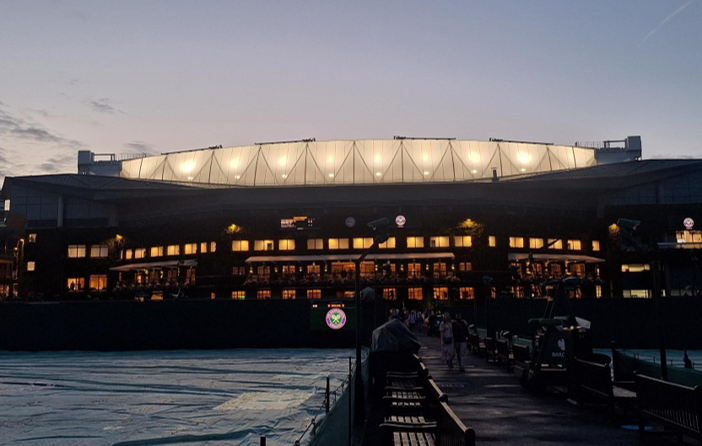
By the time we left, night was falling at the All England Club. It was a long day, but a beautiful one. Who knows what Wimbledon will serve up for us next year? We just have to find our way inside.
Posted in: Feature Story, Hosts & Suppliers, Latest News, Sites & Venues, Tennis