Football vs. Football: A British Fan’s Observations on Two Sports With the Same Name
SportsTravel Senior Editor Paul Stevens attended his first NFL game after a lifetime of enjoying what Americans call soccer
Posted On: October 27, 2026 By :I’ve never watched the Super Bowl.
There, I said it. OK, I’ve seen the kickoff, and I’ve watched a few plays, but usually by the time some global musical star takes the stage at halftime, I’ve long since gone to sleep.
So imagine my wide-eyed anticipation at watching my first full football game — and in person, no less. It happened last Sunday at a football venue I’ve been going to my whole life.
If that sounds strange, imagine how I felt trying to understand what offsides are.
Such was the life of a British fan at an NFL game. This one, between the Jacksonville Jaguars and the Houston Texans at Wembley Stadium in London on October 18, marked my first American football game after decades of being a passionate follower of the sport my U.S. colleagues know better as soccer. And while the NFL is new to me, I did have something in common with the Jaguars: both of us are quite familiar with Wembley, as this was Jacksonville’s 12th game at the famed “Home of English Football.”
Don’t think, however, that I’m not familiar with football. For me and most of the world, that word conjures images of Lionel Messi, Cristiano Ronaldo and newly minted Ballon d’Or winner Harry Kane, and it has been a central part of my life as long as I can remember. I went to my first football match as a six-year-old with my father, Phil, and my twin brother David, watching my team, Portsmouth, take on Gillingham in the English Championship (the second tier of English football) at our home stadium, Fratton Park. Despite a boring goalless tie, and the fact that I was more excited by the pre-game McDonald’s donut, I had somehow caught the football bug, and I’m still infected all these years later.
In my 25 years as a football fan, I have experienced the full spectrum of emotions that would be familiar to fans in any sport. I’ve enjoyed the highs of my team winning a championship (Portsmouth took home its first FA Cup trophy in almost seven decades in 2008), taking part in a major competition (UEFA Europa League in 2008) and putting up a strong season-long showing (Portsmouth finished in the top half of the Premier League in 2008). I’ve also endured the embarrassing lows (relegated three times), bankruptcies (twice) and painful defeats (too many to count).
Even as the Jaguars became regulars in London — they’ve played there every year since 2013 except for the COVID-impacted season in 2020 — I never paid any attention to their annual visits.
All that changed on October 18. I knew to expect loud fans, teal jerseys and a lot of scoring. I never thought I’d see so many things that reminded me of my version of football.
The Game
I must first admit to being an amateur observer of “football,” and despite my best efforts to analyze the NFL rulebook, the game laws continue to go over my head.
Watching a game that you are unfamiliar with is a bit like communicating with someone who speaks to you in a different language. You can see or hear what is going on, but you cannot understand what it means.
The NFL did its best to explain the rules ahead of kick-off on the big screens, outlining the different conferences and divisions (the Jaguars play in the AFC South), the four-downs rule, and the scoring systems for touchdowns, field goals and conversions, all of which is second nature to an American. During the game itself, the in-game announcements — including remaining time and reasons for penalties — were far more prevalent than what I am used to in soccer, and the sheer number of countdowns/match statistics felt overwhelming to a first-time spectator.
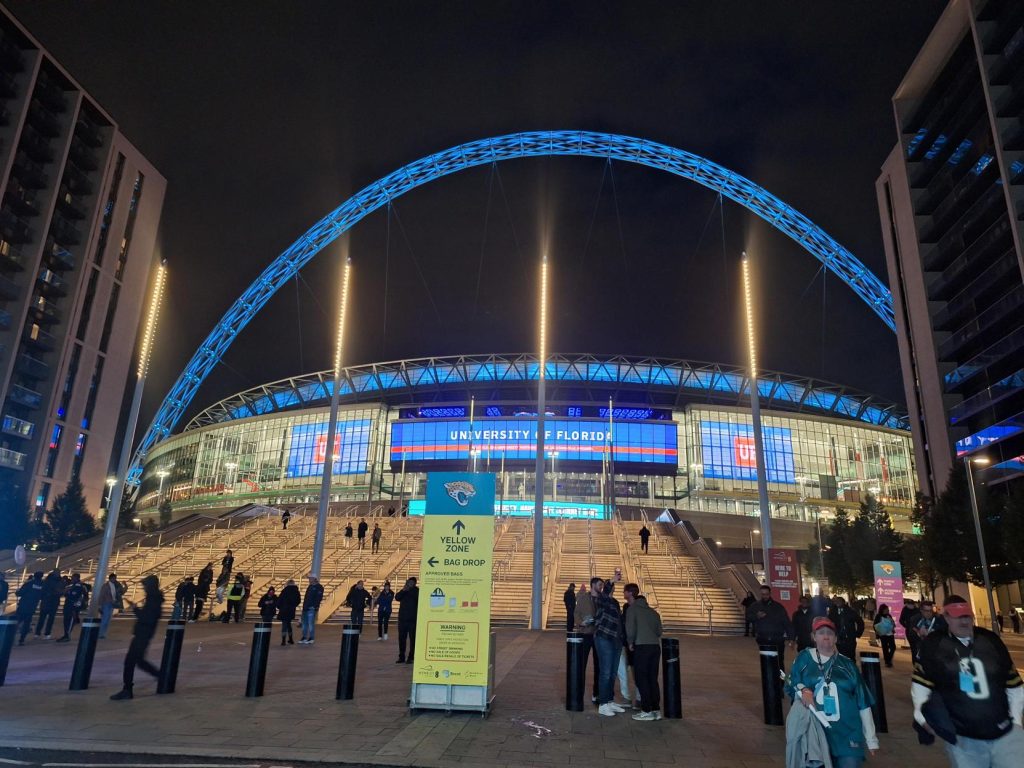
And sorry, but calling it “football” still baffles me. In an average football match that has a 60-minute clock and takes an average of three hours and seven minutes, the NFL estimates that the ball is actually in play for only 11 minutes, and kicking plays (e.g. kickoffs and field goal attempts) only make up a tiny fraction of that.
A soccer game should be easier to understand. Scoring is basic, the strategies are less complex and there are far fewer rules, at least once you get your head around the offside law. It is already a globally recognized game, and therefore, public address announcers do not feel the need to spell out the rules, even if it is your first match.
There were moments that had to be unusual even to American fans, such as the disconcerting sight of referee Larry Smith falling backwards and hurting his leg in the opening quarter. While most British soccer fans would have chanted something light-hearted for what seemed to be a comedic moment (Smith will miss the rest of the season), the NFL fans were far more supportive and simply clapped him off the pitch.
At least there was a dramatic finish, as Houston won 34-31 on a 49-yard field goal by Ka’imi Fairbairn on the final play. After speaking to my SportsTravel colleague and Managing Editor Ted Keith (whose first NFL game was a 6-3 final in freezing conditions in New Jersey) post-game, I realized I’d gotten pretty lucky.
A Passion for Pigskin
I have always known soccer fans to be extremely tribal, but I can’t fathom why the level of anger and hostility in the game is seemingly so much higher than in other sports. Intimidating the opponent is understandable, but sometimes the atmosphere can boil over when supporters let out all of their weekly frustrations.
American football games are also played with high stakes, but it was refreshing to see fans mixing calmly inside the ground without segregation. Jaguars and Texans fans weren’t alone either — I spotted plenty of Steelers, Seahawks, Dolphins, Giants and Buccaneers jerseys, to name just a few.
I would never want English soccer to lose its tribal identity — provided it is done safely — but maybe it has something to learn from its American counterparts.
Darron Abbott, a UK-based Jaguars fan and admin of the Jaguars Fan Club UK Facebook page, traveled down from Boston, Lincolnshire, just over 100 miles north of Wembley. He explained how the camaraderie among fans at NFL games had enticed him away from supporting English football, where he said he was treated more like a “number.”
Abbott went to his first NFL game in October 2016 when the Jaguars played the Indianapolis Colts at Wembley. He and his wife, Tracey, had been season-ticket holders at Manchester United for nearly 20 years, but, he says, “became very disillusioned with the way football was treating fans,” citing higher ticket prices in particular.
“We wanted to find different things, and I had never even watched the NFL,” he said. “On the way down to our first game, we had to choose which team to support. Totally clueless, we picked what we thought was the away team, the Jaguars, and as they say, that was it. We have been to nearly all of the international games since then.”
Match Experience and Activations
There is a notable contrast in the overall matchday experience between football and soccer. While soccer matches revolve entirely around the on-pitch action, football games are more spectacular and ritualistic, relying on activations and fan interactions to generate a feverish atmosphere.
Arriving at Wembley Park station at around 10:30 am, it was startling how many fans were already on site four hours before kick-off. As I walked up Wembley Way toward the stadium, I lost count of the number of stands selling official NFL merchandise, offering football-throwing competition zones and/or employing face painters catering to fans of all ages.
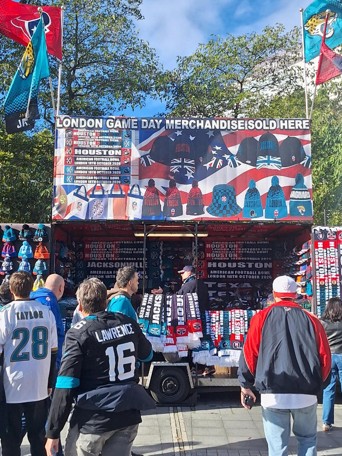
The atmosphere ramped up even more when I headed to Beers & Bites, the official NFL fan zone located by the north end of Wembley Stadium. It was rammed with food and drink stalls, a live DJ set and photo stands with cutouts of Jaguars players.
The sense of spectacle did not diminish inside the stadium. Sponsors (including Experience Kissimmee Florida, Budweiser and Marriott Bonvoy) were given regular shoutouts; there were rousing renditions of the British and U.S. national anthems, sung by Sofia Benhayoun and Laura Thompson, respectively; and Jaguars mascot Jaxson de Ville descended by rope from the stadium’s roof to heighten the crowd’s anticipation.
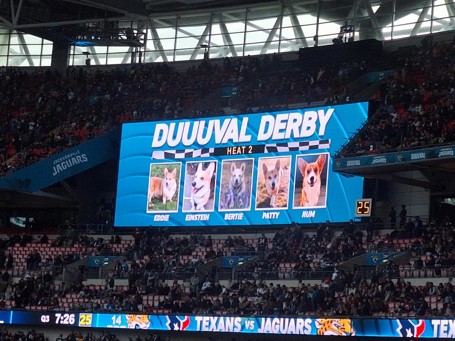
There was no halftime show, but there was an homage to a typical Jaguars home game back in Florida when this rendition of the “Duuuval Derby” — a dog race that usually features dachshunds — utilized British favorite corgis instead.
It was certainly a stark comparison to soccer matches that I’ve attended in Britain. Fans generally arrive at the stadium minutes rather than hours before kickoff after leaving the pub, although clubs are increasingly introducing fanzones and entertainment options at their venues to elongate the matchday experience.
Both football and soccer matches can be expensive, but there is a debate over which offers more value. The overall matchday experience feels more comprehensive for football supporters, but too many activations can detract from the match itself. On the other hand, the match is the centerpiece of the day for soccer fans, and the quality of the game and the people you spend time with is what will keep you coming back.
Pricing
Pricing is always a sensitive topic around sports events, particularly when taking an event or competition overseas.
In the United States, NFL ticket prices are significantly higher than Premier League games in England, but they can vary greatly by opponent, location, section, day of the week, and demand. According to Bookies.com, the average cost of an NFL game for a family of four (including parking, food and beverages) was $733.80, ranging between $1,799 for the Buffalo Bills and $251 for the Cleveland Browns.
For games in London, ticket aggregator Ticket-Compare estimates that the cheapest tickets this season are 43.9 percent higher than they were in 2019. On the day of the game I attended, tickets could still be found for £335 ($446) on Ticketmaster UK.
By comparison, Premier League matchday ticket prices continue to increase in England — average match prices have risen from £38 ($51) to £58 ($78) in the last two seasons according to Ticket-Compare. While demand for Premier League football has reached record highs and attendance is not falling, more match-going fans are being priced out amidst a cost-of-living crisis.
Abbott was pragmatic about the pricing structure at NFL games, saying that the costs were comparable to music concerts and other sporting events.
“I do actually believe the pricing is reasonable,” said Abbott. “Many people do not take into account the cost of hiring Wembley, plus the cost of licensing, employing stewards and cleaning staff, and bringing teams and equipment must be phenomenal.”
Above all, sports should be about camaraderie and community. Every supporter wants to feel part of a group with a common interest, and the excitement of Jaguars and Texans fans getting to watch their team on foreign soil was palpable. Football and soccer may be very distinct sports aesthetically, but the aspects of fandom are more similar than I initially expected.
It may have been my first football game, but it won’t be the last. Just don’t expect me to start calling our version “soccer.”
Posted in: Feature Story, Football, Hosts & Suppliers, Latest News, Main Feature, NFL, Sites & Venues, Sponsors & Media, Sports Organizations