2026 FIFA World Cup Host City Guide: Atlanta, Georgia
The city will host eight matches at the 2026 tournament, including a semi-final matchup on July 15
Posted On: April 20, 2026 By : In advance of this summer’s FIFA World Cup, SportsTravel is delving into each of the 11 U.S. cities that will host matches during the event. This year’s edition will be the largest ever, with 48 teams (up from 32) and it will be the first to be staged in three countries — Canada, Mexico and the United States — with 16 host cities in total.
Up next in our series: Atlanta, Georgia, which will host Men’s FIFA World Cup matches for the first time. Atlanta is the capital and most populous city in Georgia, with a population of more than 520,000 citizens as of 2024. Situated among the foothills of the Appalachian Mountains, the city has established itself as a hub with a diverse economy, particularly in sectors such as transportation, aerospace, news and media operations, film and television production and finance. On a sporting note, Atlanta was also the host city for the 1996 Olympic Summer Games — the fourth time that the U.S. had hosted the Summer Games in its history at the time.
[Editor’s Note: Click here to read our past features on Philadelphia, Kansas City, Houston, Dallas and Miami]
[For the full list of confirmed base camps so far, click here.]
Stadium
Stadium: Mercedes-Benz Stadium / Atlanta Stadium
Capacity: 75,000
Opened: 2017
Games: Eight matches including:
-
Spain v Cabo Verde | Group H | Monday, June 15
-
Czechia/Denmark v South Africa | Group A | Thursday, June 18
-
Spain v Saudi Arabia | Group H | Sunday, June 21
-
Morocco v Haiti | Group C | Wednesday, June 24
-
Congo DR/Jamaica v Uzbekistan | Group K | Saturday, June 27
-
Match 80 | Round of 32 | Wednesday, July 1
-
Match 95 | Round of 16 | Tuesday, July 7
-
Match 102 | Semi-final | Wednesday, July 15
Location
Mercedes-Benz Stadium, which will be known as Atlanta Stadium during the 2026 FIFA World Cup, is a retractable roof multipurpose stadium in Atlanta, Georgia, which opened in 2017 as a replacement for the Georgia Dome, a venue constructed for the 1996 Olympic Summer Games.
The stadium is the home venue of NFL team Atlanta Falcons, Major League Soccer’s Atlanta United FC and an expansion team of the National Women’s Soccer League. It is owned by the state of Georgia through the Georgia World Congress Center Authority and operated by AMB Group, and cost an estimated total of US$6.1 billion when construction was completed in 2016.
Operating with a capacity of 75,000 during this summer’s FIFA World Cup, the stadium will host eight matches in the tournament, including a semi-final on July 15. It has also previously staged the SEC football championship game, the Peach Bowl and the College Football Playoff National Championship (2018 and 2025), MLS Cup matches and Super Bowl LIII (2019), while it will welcome Super Bowl LXII in 2028.
Team Base Camps
Uzbekistan’s Men’s National Soccer Team will set up a team base camp training site at the training facilities of Major League Soccer franchise Atlanta United in Marietta, Georgia, ahead of its first appearance at a Men’s FIFA World Cup. They will also stay at the same facilities in the city between matches and training sessions, according to reports.
Fabio Cannavaro’s men will compete in Group K at the 2026 FIFA World Cup, with their first match coming against Colombia on June 17 in Mexico City. They will then head to Houston to play Portugal on June 23 and finish up their group stage campaign against an intercontinental play-off winner (either Congo DR, Jamaica or New Caledonia) in Atlanta on June 27.
Fan Experience and Activations
Working with the Georgia World Congress Center Authority (GWCCA), the Atlanta World Cup Host Committee has announced that there will be a FIFA Fan Festival Atlanta in Centennial Olympic Park, and that it will be free for all visitors. According to Committee President Dan Corso, there will be a focus on live match broadcasts, fan activations, cultural programming and food and beverages that highlight the intersection of global soccer culture and Southern hospitality.
The Festival is set to open on June 11 (the opening day of the tournament) and end of July 15, when the city hosts a semi-final. The park will be divided into four distinct zones: the Main Stage for concerts and live events, complete with a 40-foot screen to broadcast matches, The Playground for younger fans; The Pitch for community programming, podcasts and AR/VR experiences; and Georgia Street, which will showcase local artists and food vendors.
Accommodation Supply
According to short-term rental data provider AirDNA, the 2026 occupancy rate at the time of the group-stage games in Atlanta is up 74 percent compared to 2025 (from 13 percent to 22 percent occupancy).
The games with the most year-over-year demand increase are Cape Verde vs. Spain at +108 percent on June 15 and Saudi Arabia vs. Spain at +103 percent on June, showing that reigning European champion Spain is currently leading the way in demand. At the same time, occupancy is roughly the same though across group stage between 21 percent and 23 percent.
On pricing, the average booked rate across group stage dates is currently $211, a YoY increase of only 29 percent. The average available rate, however (the price listings currently marketed at), is sitting at $341, a 92 percent increase compared to 2025.
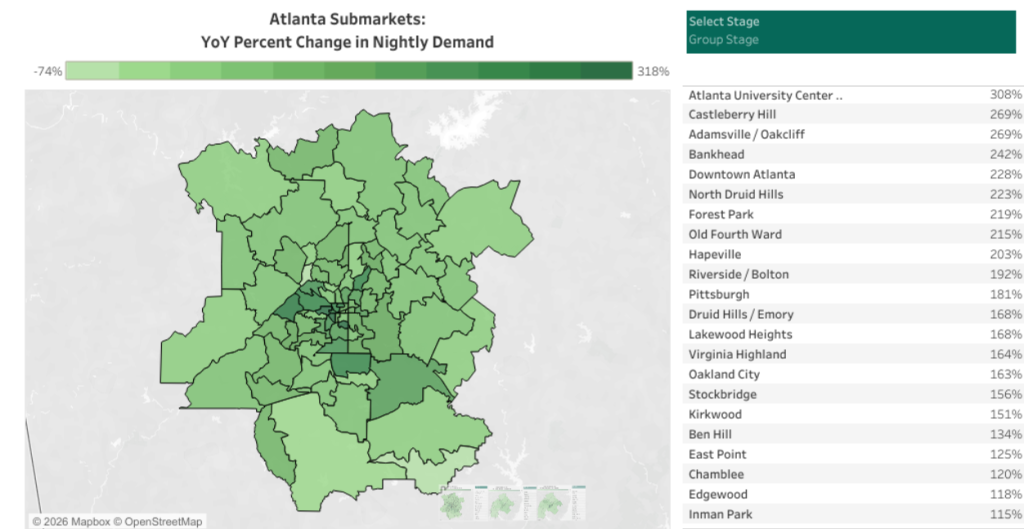
For the Round-of-32 games, the occupancy rate is shooting up 99 percent compared to 2025 (from only nine percent to 18 percent occupancy). Match 80, happening on July 1, is already driving a 115 percent YoY increase in demand.
For the Round-of-16, the occupancy rate is up 114 percent on 2025 levels (from nine percent to 20 percent). The average available rate for this round is also the highest of the tournament for Atlanta, currently at $383 (133 percent higher than last year). And Match 95, happening on July 7, is already driving a 123 percent YoY increase in demand.
Below are the demand repartitions at the neighborhood level for Atlanta across the World Cup group stage:
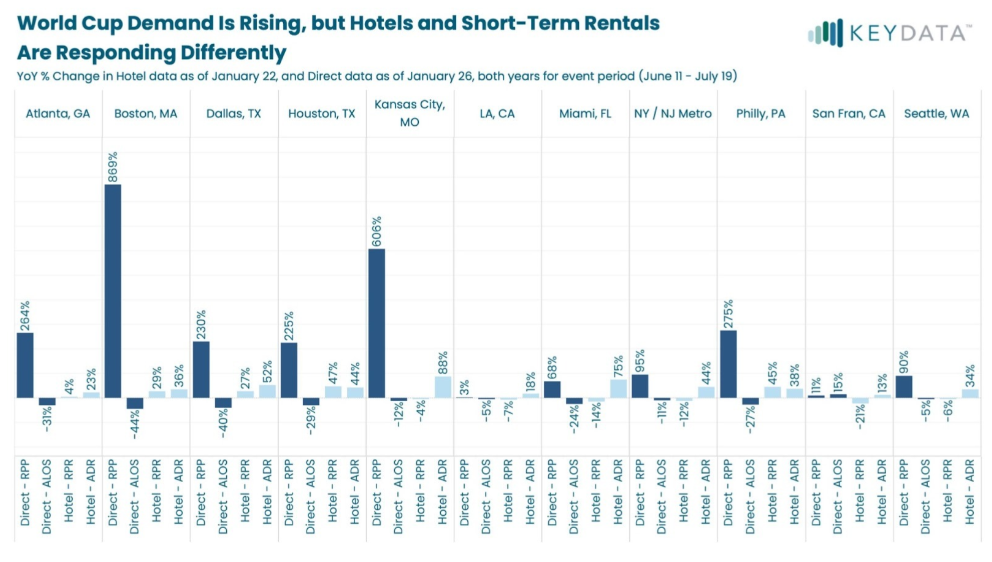
As per Key Data, the chart below underlines that Atlanta, Georgia, is seeing the fourth highest increase in short-term rental reservations per property (+264 percent), behind only Boston, Massachusetts, Kansas City, Missouri, and Philadelphia, Pennsylvania. Unsurprisingly, the length of stay drops sharply by 31 percent (the third-steepest drop of all 11 U.S. host cities) as fans move on to other cities or head home after games. On the hotel side, reservations per room and average daily rates are seeing only marginal gains during the tournament compared to other U.S. host cities, at just four percent and 23 percent respectively.
And according to CoStar forecasts, Atlanta is currently seeing the lowest hotel average daily rate and YoY average daily rate change of all the 11 U.S. host cities. The city’s average daily rate during the tournament is $133.15 (just below Houston’s $136.24) and its ADR YoY growth from 2025 is only 0.05 percent
Despite hosting a substantial eight matches at the tournament, it appears that Atlanta is seeing weaker-than-expected accommodation and hotel demand. This could be attributed to high ticket prices and international fans scaling back their plans, while FIFA recently cancelled thousands of reserved hotel rooms and high initial room rates, which has forced operators to reduce their prices by around a third in a bid to attract last-minute visitors.
Q&A: Dan Corso, president, Atlanta World Cup Host Committee / Atlanta Sports Council
What does it mean to you and Atlanta to be hosting the FIFA World Cup?
Hosting the FIFA World Cup 2026™ is a once-in-a-generation moment for Atlanta and the state of Georgia. The FIFA World Cup is about more than matches; it’s about people, culture, and highlighting Atlanta’s spirit and Southern hospitality on the world stage. 30 years ago, the world came here for the 1996 Olympic Games, and that experience transformed this city. Atlanta is built for this — big events are what we do well. When you think about what the Olympic Games meant to Atlanta’s infrastructure, its profile, and its identity, we genuinely believe the FIFA World Cup will have a comparable impact. We’ve spent the past decade building Atlanta into a soccer city. We’ve proved the appetite is here. Now the world gets to see it.
What are the major opportunities the tournament will bring?
The opportunities are present at every level: economic, cultural and reputational. A Metro Atlanta Chamber analysis conservatively estimated $503 million in economic impact — and that figure only counts out-of-state visitors. But the numbers only tell part of the story. Atlanta attracts more than 50 million visitors a year, but only a small percentage come from outside North America. The FIFA World Cup is our chance to change that permanently. We’re going to get to show off the city, and we hope those visitors go back home, tell their friends, and come back again and again.
What are some of the logistical / operational challenges that have to be negotiated before and during the tournament?
Hosting an event like the FIFA World Cup is incredibly complex. Some of the main operational pillars are transportation, security and accommodation. On transport, Metropolitan Atlanta Rapid Transit Authority (MARTA) will be running increased service to keep waits to a minimum, and we’ve been working through every scenario for moving hundreds of thousands of people around the city safely and efficiently. On security, it’s a collaborative effort between Atlanta PD, the Georgia Bureau of Investigation, Georgia State Patrol and federal partners. Preparing for the FIFA World Cup is a massive team effort from leaders across public and private sectors. We’ve been fortunate to have hosted major global events in recent years — Super Bowls, the College Football Playoff National Championship and the Club World Cup last summer — and that experience has helped foster a spirit of cooperation across city, state and regional organizations that I think sets us apart.
What kind of welcome can fans expect when they attend World Cup matches in tournaments?
We want every person that steps foot in Atlanta to feel welcome and to feel the energy that defines our city. We want every fan’s experience in Atlanta and at Mercedes-Benz Stadium to be unforgettable. What makes Atlanta unique is that we are genuinely an international city — we have the world’s busiest airports, an extraordinary food and hospitality scene, and communities from several nations that will be competing in this tournament. Atlanta is ready, and whoever comes here, we’re ready to provide the best experience possible for everyone. We’ve also been engaging directly with consulates and diplomatic missions to understand travel patterns, cultural needs and fan behaviors so we can tailor the experience for each visiting nation rather than applying a one-size-fits-all approach.
Are you working on any legacy campaigns for after the tournament has ended?
Absolutely, and with local programs like Soccer in Streets already an integral part of our community, this is something we’re very passionate about. We’ve announced a FIFA 2026™ Legacy Project to support the development of a new StationSoccer location at the Hamilton E. Holmes MARTA Station, in partnership with Soccer in the Streets, creating a community hub where youth programming, transportation, education, and resources come together. We’ve also formalized a significant statewide partnership with the Boys & Girls Clubs of Georgia, which will deliver programs and resources across communities including Albany, Athens, Augusta, Columbus, Dalton, Savannah and many more — so that the FIFA World Cup reaches our entire state.
Do you expect to confirm any more team base camps in Atlanta and the surrounding area?
Atlanta United’s training facilities in Marietta are well positioned to support teams choosing the region for their base camp during the tournament. Atlanta is one of the most diverse cities in the U.S., with vibrant communities from around the world, making it a natural fit for welcoming international teams and fans. As plans take shape and teams finalize their base camp arrangements with FIFA, we’re proud to have strong training and preparation facilities here and look forward to supporting any teams based in Atlanta.
Anything else we might have missed?
One thing I’d emphasize is the scale of what we’ve already rehearsed. Atlanta does big events and does them well. We are testing and refining every operational plan we have. The other item worth noting is just how deeply soccer has taken root in this city. Atlanta United debuted at Mercedes-Benz Stadium in 2017, and the city has risen to become a major soccer destination in the years since. That’s underscored by the fact that U.S. Soccer is relocating its national headquarters and training center to the Atlanta area — a vote of confidence in this city as the epicenter of soccer in America. This tournament is in some ways the culmination of that journey.
Posted in: 2026 FIFA World Cup, Feature Story, Hosts & Suppliers, Latest News, Sites & Venues, Soccer, Sponsors & Media, Sports Organizations, Sports Sponsorship, Sports Venues