

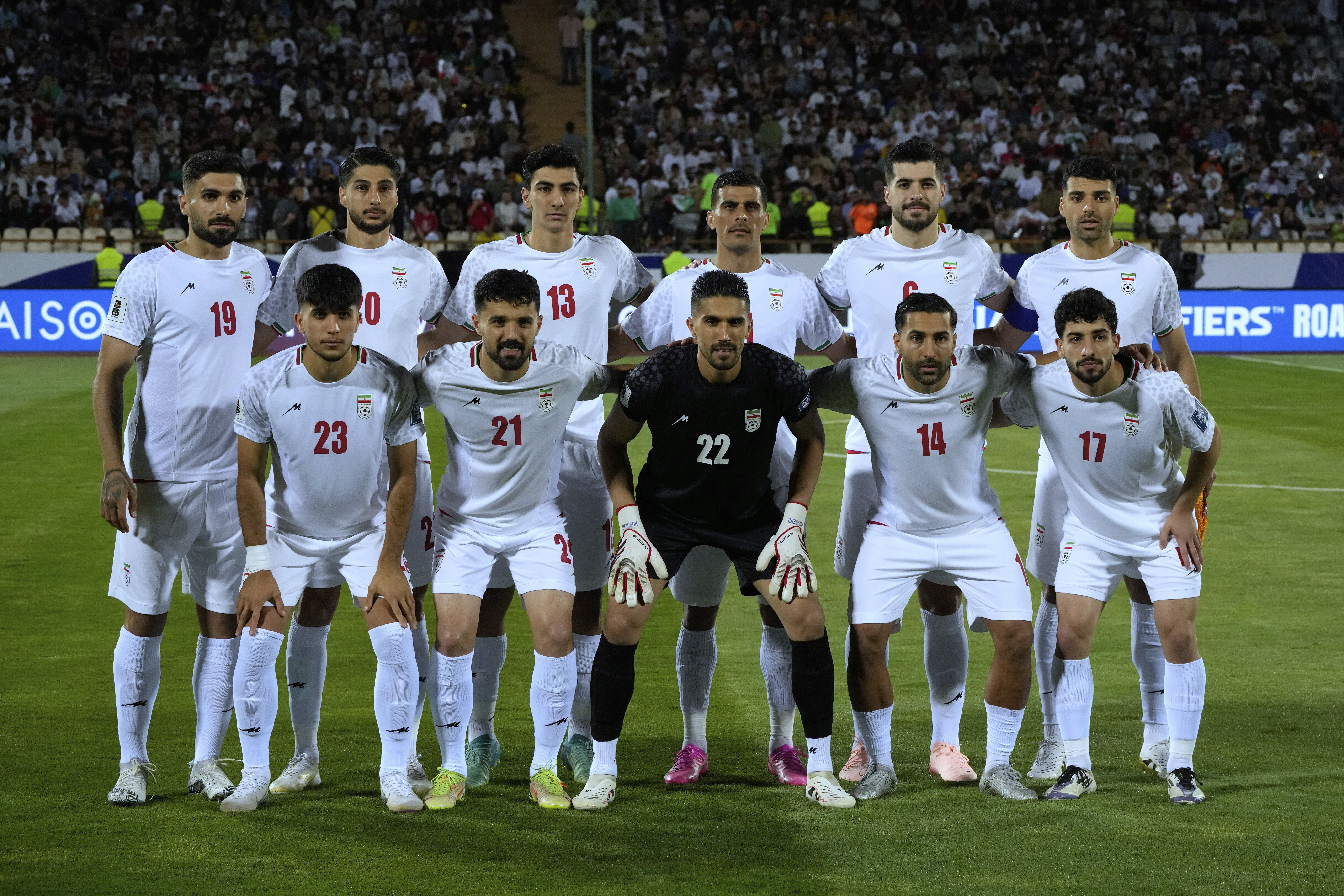
Iran’s participation in the 2026 FIFA World Cup, to be held in North America, is in doubt after the president of the country’s soccer federation admitted that he was unsure if the men’s national team would be able to fulfill matches at this summer’s tournament, following its missile attacks in the Middle East over the weekend and strikes from Israel and the United States.
“What is certain is that after this attack, we cannot be expected to look forward to the World Cup with hope,” Mehdi Taj told Varzesh3 after Iran responded to US-Israeli strikes which killed Iranian Supreme Leader Ayatollah Ali Khamenei with retaliatory attacks on military bases and residential areas in Qatar, the United Arab Emirates, Israel, Kuwait, Bahrain, Saudi Arabia, Jordan, Cyprus and ships passing through the Strait of Hormuz.
The United States and Israel reportedly set out to target Iranian missile infrastructure, military sites and senior leaders with its strikes, while U.S. President Donald Trump had called for the country’s government to be overthrown to “ensure that Iran does not obtain a nuclear weapon.”
Attacks on both sides have continued into their third day on Monday, March 2 as the United States and Israel pursue their military goals, and Iran seeks to avenge its late leader’s death. Shia militia group Hezbollah, which is backed by Iran, has also joined the fighting by launching rockets into Israel from its bases in Lebanon.
Rumors began to emerge over the weekend that Iranian national team officials were considering withdrawing from the tournament due to political tensions in an almost unprecedented move. Austria (1938), Türkiye (1950), Scotland (1950), France (1950) and India (1950) have previously withdrawn from the tournament due to a mix of reasons, including Austria’s occupation by Nazi Germany and because India was not allowed to play barefoot.
If Iran, known officially as the Islamic Republic of Iran, were to withdraw, FIFA could look to invite a replacement team from the Asian qualifying section to participate in the tournament. That could be Iraq, which is due to compete in an inter-confederation play-off with Bolivia and Suriname later this month, or the United Arab Emirates, which lost out to Iraq in the fifth round of Asian qualifying as it sought a debut appearance at a Men’s FIFA World Cup.
In response to the attacks, FIFA Secretary General Mattias Grafström stated that the organization would “communicate as we always do with the three (host) governments” and that “everybody will be safe.”
World Cup Future
Iran is due to compete in Group G alongside Belgium, Egypt and New Zealand, playing matches in Inglewood, California, and Seattle, Washington. It has also selected a team base camp training site in Tucson, Arizona, for use between traveling to matches and staying at its hotel.
It would be the country’s third consecutive FIFA World Cup and its seventh in total. However, it has yet to progress beyond the group stages of soccer’s pinnacle national team competition.
Iranian team representatives previously threatened to boycott the Final Draw in December after members of their team were denied visas, but they eventually reversed their decision. Iran, however, is one of at least 75 countries whose citizens are restricted or banned from entering the United States due to a directive issued by President Trump, which currently effectively prevents Iranian fans from attending the tournament.
President Trump’s immigration crackdown has led to the suspension of the processing of immigrant visas for citizens of at least 15 World Cup qualified nations, including Algeria, Brazil, Cape Verde, Colombia, Egypt, Ghana, Haiti, Iran, Ivory Coast, Jordan, Morocco, Senegal, Tunisia, Uruguay and Uzbekistan, who may not be able to attend.
The 2026 FIFA World Cup, which has been expanded to 48 teams, will begin with Mexico vs. South Africa on June 11 on Mexico City, with the final being held on July 19 in New York New Jersey.










 Copyright © 2026 by Northstar Travel Media LLC. All Rights Reserved. 301 Route 17 N, Suite 1150, Rutherford, NJ 07070 USA | Telephone: (201) 902-2000