
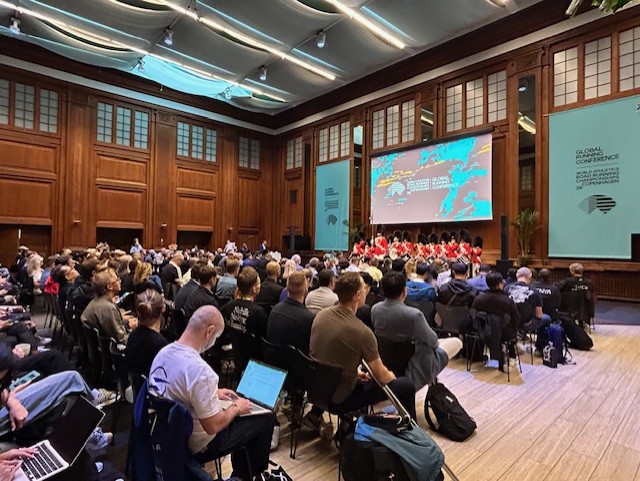
COPENHAGEN, Denmark — The current state of the running industry, case studies of emerging marathon events around the world, and the future of mass participation sports globalization were all on the agenda at the 2026 Global Running Conference in Copenhagen, Denmark.
Hosted by World Athletics in collaboration with Danish Athletics, the fifth edition of the Global Running Conference (following previous editions in Spain, Thailand, Latvia, and one virtual edition during the Covid-19 pandemic) brought together more than 200 event organizers, federations, cities and commercial partners to explore how road running can remain relevant, resilient and socially valuable in the coming years. It featured keynotes, panel discussions and interactive workshops with speakers from across the running space to address the latest trends and innovations in event delivery, and to identify useful practical case studies.
Coinciding with the second edition of the World Athletics World Road Running Championships in the city, the conference created a festival-like celebration of road running, while still reflecting on what lies ahead for the industry. SportsTravel Senior Editor Paul Stevens was on site in the Danish capital to gather his five key takeaways:
Innovation is Vital
World Athletics President Lord Sebastian Coe, a two-time Olympic gold medalist in the 1500 meters, was a keynote speaker at the conference, and he took the opportunity to discuss how the running industry must continue to innovate in order to survive in fragmented sports and media landscapes.
Coe cited that weekend’s expanded World Road Running Championships in Copenhagen, the recent inaugural Ultimate Championship in Budapest, Hungary, and the upcoming Run X (a first global 5k World Treadmill Championship in partnership with Technogym) as examples of how World Athletics is launching new events and formats that will appeal to new and existing athletics fans, and elite and mass participation event runners.
By embracing new formats (including fresh disciplines, inviting only the world’s top-performing runners, integrating entertainment and athlete spotlights, etc) and technology (using “connected” Technogym treadmills for Run X), the president was keen to insist that the international federation is adapting to an evolving market, where younger generations of fans are engaging differently with sports (e.g. on short-form social media), and to the push for stronger health, economic and educational policies.
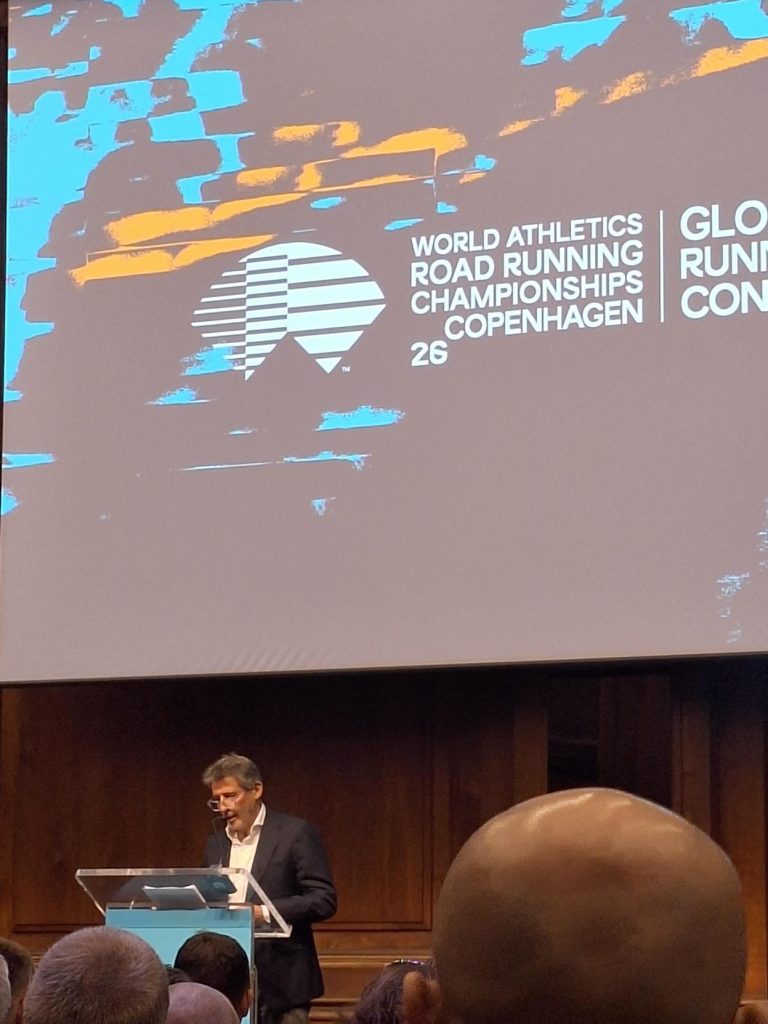
Furthermore, Coe suggested that event organizers must have “the bravery and resilience to do new things and not listen to siren voices,” as well as to “focus on it like your life depends on it,” because some events have previously been left “stranded” due to a lack of innovation, investment and structured plans. In a world that is facing increasing climate, geopolitical, economic and digital challenges, he suggested that running has the unique ability to connect borders, generations and policymakers when it comes to promoting a healthy, active lifestyle.
Improvement, Optimization and Wellness
Coe also spoke of the warning that sports had a responsibility to demonstrate their value to governments in terms of public health benefits, social cohesion and resilience. That message was echoed by Andreas Moll, vice president of categories for Asics’ Europe, Middle East and Africa division, who explored the who, what, why, where and when of the cultural shifts currently occurring in the running industry.
Using his own activewear company’s research dating back to the outset of recreational running in the 1950s, Moll surmised that the running industry was going through a “building” phase rather than a “boom” period, which had accelerated in particular since the isolation of the Covid-19 pandemic around 2020. Since then, global running participation has experienced 2.5x growth on average each year, as motivations around running have progressed from simply running to improve one’s health to building one’s social identity and creating a sense of escapism.
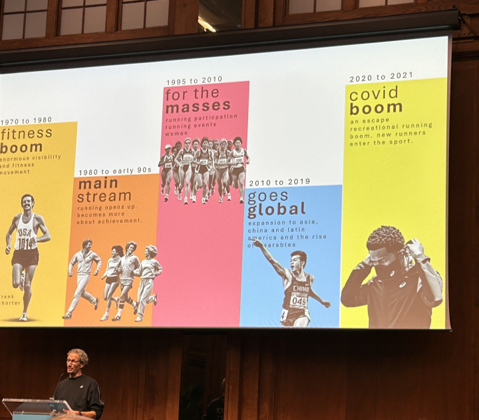
In the next era of running motivations, however, Moll believes that the segment is approaching a consolidation phase, which will be defined by improvement, optimization and wellness. Participation in events such as marathons and half marathons globally and local run clubs/communities will continue to grow (the UK leads the way worldwide with 21 percent run club/community participation of all runners), but there is still work to be done to encourage runners over the age of 40 to get involved and to keep race bib prices affordable. As the number of people taking up running in the 18–29 and 30–39 age brackets surges, emerging runner demographics will take a greater interest in nutrition, AI-powered training platforms and wearables/measurable equipment for the purpose of longevity — running to live better for longer.
Dr Vassil Girginov, professor in Sport Management/Development at Brunel University London, repeated the message that running can serve as both a wellness and social mechanism. He recommended that event organizers integrate elements of mindfulness (e.g. pre-race meditation), promote physical benefits of exercise, and reward participants who achieve personal goals in order to achieve the full potential of their events for all groups.
Personalized Events = Economic Engines
Hisham Shehab, co-founder and chief operating officer of N3XT Sports, leaned further into the human connection dynamic of mass participation running events, but this time advocating for the integration of more AI personalization in their event strategies.
Shehab intimated that, as more marathon and mass participation events are launched across the world, they were at risk of becoming too “transactional” by not engaging with previous years’ participants and other running enthusiasts who had subscribed for more details about the events. Instead, race event organizers should focus on personalizing their engagements with runners all-year-round, and work closely with tourism boards and local representatives to ensure that they are promoting their locations as unmissable weeklong destinations for potential participants.
N3XT Sports, a consultancy business that specializes in the transformation and modernization of the sports industry, advises event organizers to integrate features such as single runner records, tailored runner and spectator experiences (e.g. data insights) and personalized automated notifications. These give communities a reason to care beyond the races and provide value to all parties, including organizers, participants, spectators, volunteers, and city operations leaders.
Ultimately, races are economic engines for host cities and destinations, serving government stakeholders, hotels, destination marketing organizations, accommodation providers and travel agencies alike. It also shows that while technology and AI are useful tools for managing operations more seamlessly, event organizers are still the core components for delivering successful events.
Simplicity is Best
A running thread throughout the Global Running Conference was that the most well-organized events are also the simplest in format.
Take World Athletics’ new Ultimate Championship, for example: the world governing body created a premier, biennial, end-of-season event that invites only the top runners from across the globe, including Olympic champions, world champions and Diamond League winners, all of whom compete for a share of a record $10 million prize purse. The event itself was condensed into three action-packed evening sessions with smaller fields, no preliminary heats, and structures with either semi-finals and finals or just finals alone.
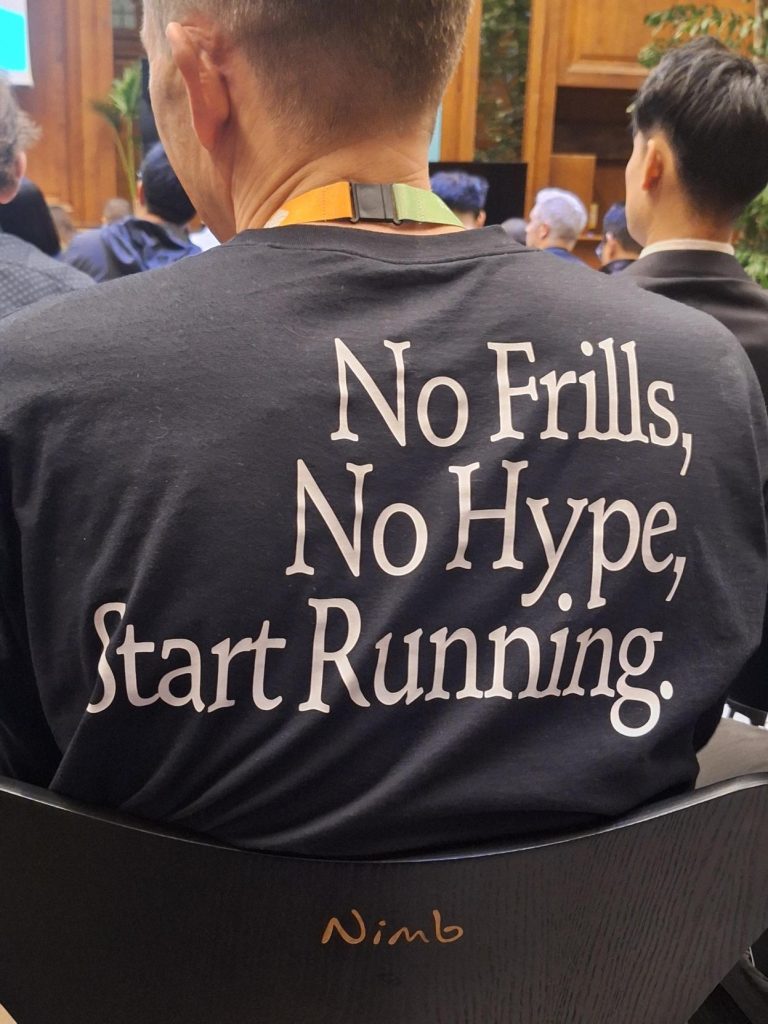
That is the direction that mass participation events are heading in, too, from both a fan and an athlete perspective. Streamlined but structured events keep more fans engaged in stadiums and on TV or social media, while events like SuperHalfs (a collection of half marathons in Lisbon, Portugal; Prague, Czechia; Berlin, Germany; Copenhagen, Denmark; Cardiff, Wales; and Valencia, Spain) are thriving because they have easy-to-understand formats that keep runners coming back for more. Furthermore, SuperHalfs added an element of gamification, such as introducing “Superstamps” or “Supermedals” when one completes each race, to forge a community of runners all aiming to achieve the same goal.
But as more races and franchises achieve global scale, they should also retain the local soul that made them popular in the first place, according to Running Industry Alliance, UK & Ireland Founder and CEO, Rebecca Richardson. She warned that some events were scaling “too quickly” in pursuit of market leadership, and that organizers should prioritize building concepts that work and establishing loyal communities.
Sustainable Running Events are Possible
For many years, one of the biggest elephants in the room at large mass participation events worldwide has arguably centered around sustainability, and the environmental footprint left behind after the races have concluded. And yet, there are encouraging signs now that event organizers are taking their sustainability responsibilities more seriously.
Lauren Proshan, chief of race operations and production at Boston Athletic Association and the Boston Marathon, explained how that organization’s key foundational pillars were based around environment, people and communities, and responsible governance, to ensure it can meet its environmental, social and economic targets by 2030. Last year’s Boston Athletic Association events, including the marathon, 10k and 5k, welcomed 60,000 runners, hosted 10,000-plus volunteers and delivered $509 million in measurable economic impact, and a year earlier, it operated directly on 100 percent renewable electricity for the first time.
By 2030, the B.A.A. wants to achieve its target of reducing Scope 1 (direct greenhouse gases from owned or controlled sources) and 2 (indirect gases from purchased energy like electricity or heat) emissions by 42 percent, help more people experience the health, community and social benefits of running, and strengthen trust through responsible governance.
Sustainability also goes hand-in-hand with event planning, and delivering concrete actions even when something goes wrong. Jackson Tuwei, president at Athletics Kenya, referred to the 2025 Cape Town Marathon as an example where race event organizers should be working closer with scientists and meteorologists in the planning period after the marathon was canceled due to safety reasons from local thunderstorms.
Race organizers are well aware of the potential of their events to boost communities, strengthen host city relations, and drive long-term engagement with the sport. The industry has modernized its formats and sought to appeal to broader audiences, as the role that running plays in our society evolves through time.
This week in Copenhagen showcased the best of the global running community, but there are warnings too about the relevance of events that do not keep up with the latest shifts and trends.
Innovation, simplicity and adaptability are essential for the survival of the sport in the long run.










 Copyright © 2026 by Northstar Travel Media LLC. All Rights Reserved. 301 Route 17 N, Suite 1150, Rutherford, NJ 07070 USA | Telephone: (201) 902-2000