

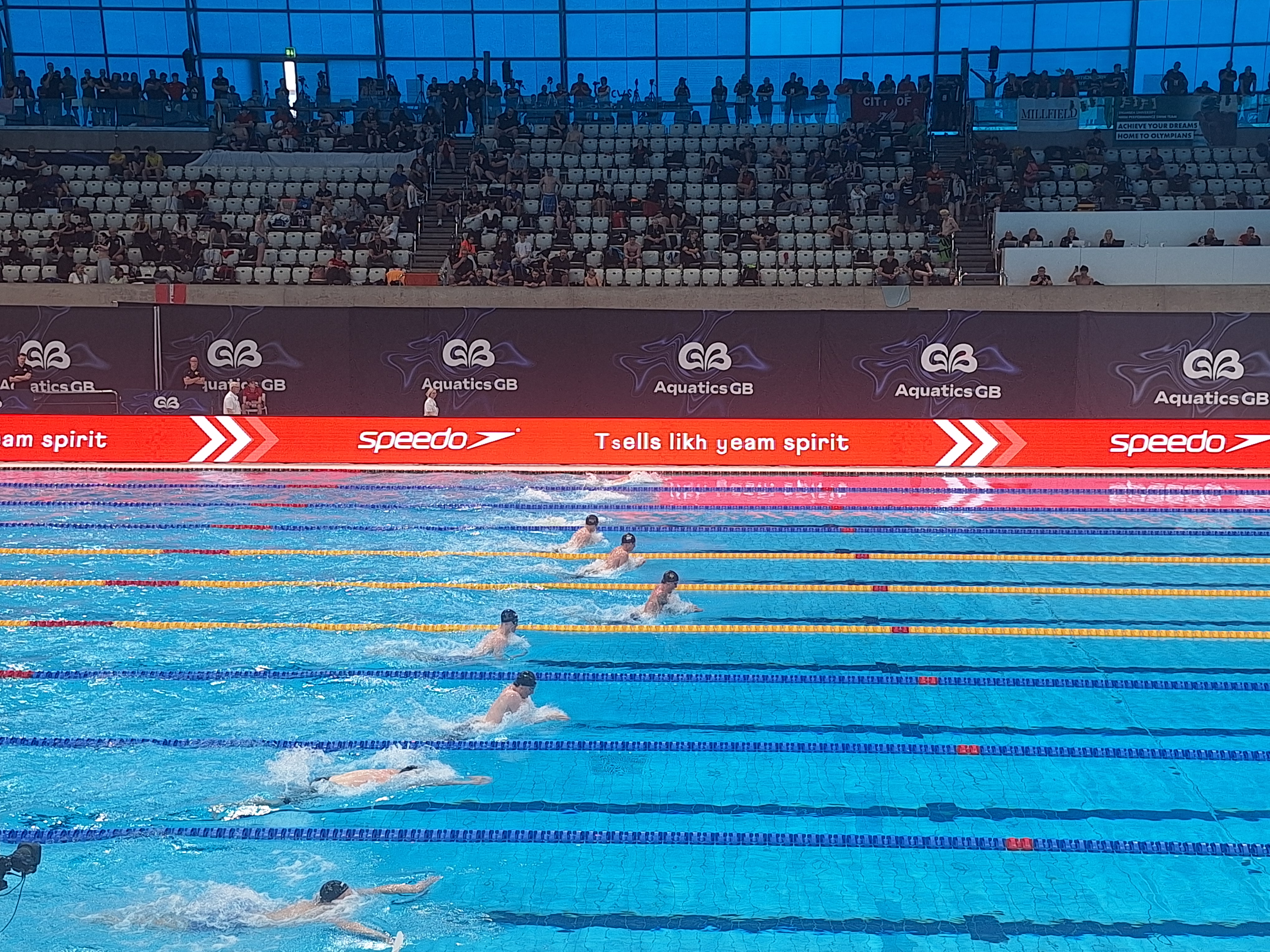
This year’s Aquatics GB Swimming Championships showcase the depth and diversity of British swimming talent, and serve as a tantalizing glimpse into what will be a busy sporting summer.
Taking place on the hallowed grounds of the London Aquatics Centre in the Queen Elizabeth Olympic Park, the home of the London 2012 Olympic and Paralympic Summer Games, the Championships brought back memories of Rebecca Adlington cementing her status as a British swimming icon with her third and fourth Olympic medals. This year’s crop of athletes, competing across 36 medal events from April 14—19, will be seeking to emulate her success.
This is also one of the final meets before this summer’s European Aquatics Championships in Paris and the Commonwealth Games in Glasgow, Scotland. It therefore represents a crucial opportunity for athletes to not only impress selectors for the Commonwealths, but also to qualify for their respective disciplines in Paris and compete with the continent’s best, provided they swim within the recorded qualifying times.
Traveling from across the country, swimmers of different ages and classifications — from juniors to Olympic and para swimmers — converged on London to make their mark and secure British championship titles.
Below is a deep dive into the moments that stood out from Day One of the Championships:
Slick Operations, Fervent Atmosphere
This was my first time attending a proper swimming meet and I couldn’t help but feel struck by the enormity of the Aquatics Centre. This is the third year of a five-year deal for the Centre to host the Championships leading up to LA28, and the venue is undergoing planned improvements for community use with a new exercise studio, spin studio, gym and F&B services, as part of Everyone Active’s takeover in 2023.

In the main pool, there were five heat events in the morning (Women’s 50m Breaststroke, Men’s 400m Freestyle, Women’s 200m Butterfly, Men’s 100m Breaststroke and Women’s 100m Freestyle), featuring a mix of British record holders, Olympic and Paralympic champions and emerging talent. This was followed by eight “Big” finals in the evening, as well as junior finals and “B” finals for the next 10 athletes in their classifications who were not quite fast enough to qualify for the Big finals.
The crowd could have been forgiven for producing a fairly muted atmosphere given the 50-plus heats in the morning and the fact that the vast majority of the athletes are not (yet) household names, but that certainly did not dampen their appetite for swimming action.
Swimmers representing clubs and universities were competing to qualify for the finals, achieve personal bests and surpass records to become British champions in their classifications. Across the venue, flags and banners adorned any spare sections of walls available (from Universities of Surrey, Aberdeen, Bath, Birmingham, Stirling and Loughborough, and clubs from Liverpool, Crawley and High Wycombe), and alongside the booming DJ music, flashing light shows and beaming sponsor boards (for Uber Boat, Speedo and Science in Sport), it made for an electric atmosphere.

For my first time at such an event, the juxtaposition of noise was immediately striking: DJ walk-on music for the athletes and then manufactured heartbeat sounds that played out just before they took their marks followed by the hushed silence at the very start of the race and finally the encouraging roar of the crowds.
Equally striking was the operation behind the scenes to keep everything on track. At any one time, referees, support staff, trainers, lifeguards, media, camera people, photographers and selectors were all moving about, taking or giving instructions so that everything worked as seamlessly as possible for the athletes.
The atmosphere was notable in other ways. The venue was intentionally kept around 27-28 degrees Celsius to reduce evaporation and minimize chill for swimmers when leaving the pool, but it was hard not to notice the heat inside.
Inclusivity
These Championships were billed as a gathering of the best swimmers in Britain. And yet, it was the inclusion of Olympic pathway and para swimmers as well as junior athletes in this meet that was even more inspiring.
Names such as Adam Peaty (three-time Olympic gold medalist in 50m and 100m Breaststroke), James Guy (three-time Olympic gold medalist in Freestyle and Relay events) and Freya Anderson (Olympic gold medalist in Mixed 4x100m Medley Relay) may generate the most ticket sales, but attendees were also treated to a host of up-and-coming stars eager to prove that they too can be title holders one day.

For para athletes competing with visual, intellectual or physical impairments, meets like these show the power of sports. They are competing in the same pool as their Olympic pathway counterparts yet their performances are even more remarkable because they feel empowered — rather than defined — by their impairments.
Before the first “Big” final of the evening, a lady seated next to me asked me to cheer on her son who was competing in the next race. She explained that her son had cerebral palsy, which makes movement difficult on the left side of his body. He didn’t win his race, but his achievement in getting this far spoke volumes, and his parents’ pride in him was obvious. Together they had traveled the world for these events, from their home in Essex, England, to Singapore, France and the United States.
Each para swimmer is given one of 14 para classifications depending on the type and extent of their impairment, from S1 to S14, with the lowest numbers being the most severe impairments. These classifications are designed to make the qualification system as equitable as possible, and whether the para athletes are competing with swimmers in the same classification or not, they are ranked by points and not specifically by speed to advance in the competition — with points calculated by how close they finish to the world records in their respective para classifications.
To make the experience as comfortable as possible, para athletes can be held on their starting blocks by support staff or tapped on the back by what can only be described as a long pole with a ball on the end to indicate that they are getting close to the pool edge. Other recent adaptations for all swimmers are multiple bell rings with 100m to go and lap cards with 50m to go: changes that were made especially for these Championships just weeks ago.
Who would bet against names like Manchester’s Bruce Dee and Hornchurch’s Kai Bradford, who each broke British records in the Men’s 100m Breaststroke, making it on to the Paralympic podium at LA28?
As Aquatics GB CEO Drew Barrand said this week: “Our Aquatics GB athletes can inspire the next generation of swimmers so when we run an event, we make the access happen.”
Journey to The Commonwealth Games
For a number of the athletes in London this week, the Aquatics GB Swimming Championships were just the starting point for what will be a rigorous but also exciting 2026 season.
Starting July 31, the 38th edition of the European Aquatics Championships will be held at the Olympic Aquatic Centre in Paris St Denis. It will be the first major international championships at the venue since the Paris 2024 Olympic Summer Games and will take place 100 years after the first edition in Budapest in 1926.
On the first night of finals in London, recognizable names such as Peaty and Guy finished within the qualifying times to secure their spots in Paris, but other names hoping to make a splash include Keanna MacInnes (University of Stirling), Emily Richards (Newcastle-upon-Tyne) and Repton’s Eva Okaro.
It must be mentioned that achieving the necessary time does not necessarily guarantee a spot on the team; athletes must still be tapped by their national selectors and be placed within team size limits to advance.

Meanwhile, the Commonwealth Games are being held in Glasgow, Scotland, from July 23 through August 2. This year’s multi-sport event has been scaled down to 10 sports (after the Australian state of Victoria withdrew from hosting duties in July 2023) and will feature 3,000 athletes representing up to 74 Commonwealth nations and territories.
Like other major multi-sport events, athletes must finish within qualifying times, ranking requirements or eligibility criteria set by their own national Commonwealth Games Association (CGA). As well as experience, Commonwealth Games athletes can receive international exposure, sponsorships and prestigious medals through high-level performance, which could push them closer to eventual Olympic/Paralympic selection.
Challenges for Aquatics GB
Unfortunately, not everything has been going swimmingly for Aquatics GB lately.
Next month’s inaugural Enhanced Games, which will permit athletes to use performance-enhancing drugs in competition under medical supervision, has already provided a headache for Aquatics GB and provoked a strong backlash from the global clean sport advocates. The privately-funded event, scheduled for May 21—24 in Las Vegas, will feature swimming alongside sprinting and weightlifting, offering $1 million prize money if athletes achieve world record-breaking performances.
While the Enhanced Games creator Aron D’Souza says that the multi-sport event will “pioneer a new era in athletic competition that embraces scientific advancements to push the boundaries of human performance,” its detractors describe it as a “high-risk social experiment” that undermines the integrity of clean and fair sport.
In January, Emily Barclay was the second British swimmer after Ben Proud to confirm her participation in the Enhanced Games. At the time of Proud’s announcement, Aquatics GB released a brief and damning statement explaining that the athlete was “no longer in receipt of any public-funded monies or services provided by Aquatics GB” and that the organization “stands behind the true values of clean sport,” while “any entity that does not uphold this ideal has no credibility in competitive sport.”
There are other pain points. Despite hugely successful medal hauls from the last two Olympic Games (eight medals in Tokyo and 11 in Paris) Aquatics GB has seen a lack of recent individual medals in women’s swimming, a strong reliance on some of its veterans (e.g. Guy or Duncan Scott) for senior podium success and burnout questions exemplified by Peaty’s absence for mental health recovery in 2023. Earlier this year, research by the British Swimming Coaches Association also highlighted high levels of emotional exhaustion among swimming coaches, with two-thirds of UK swimming coaches reporting symptoms of depression and anxiety.
Oddities
Even in a tightly-choreographed environment, there was an opportunity to glimpse the unexpected.
In Heat Three of the the men’s 100m breaststroke, the race appeared to have passed by smoothly until afterward when it was announced that there would be a rare circumstance of a rerun. It turned out that there had been a faulty starter microphone in Lane Eight, leaving the swimmer in that lane at a potential disadvantage as their starting reactions may have been momentarily delayed.
In the event of a rerun, all swimmers are offered the option of reviews with the opportunity to either race again and improve their time or stick with the initial time they achieved. In this case, eight of the 10 swimmers accepted the chance to race again and two did not participate due to their performance in the original heat.
Wycombe District Swimming Club’s Marcus Haigh was the biggest beneficiary as he won the rerun heat and qualified for that night’s final, improving his time by a significant two seconds to 1:04:27.
And then when exiting the venue at the end of the heats in the early afternoon, I noticed a restaurant owned by renowned celebrity chef Gordon Ramsay.

Something like that might usually have been fairly innocuous but the irony is that Ramsay is now Adam Peaty’s father-in-law (having married Gordon’s daughter Holly in a lavish ceremony in Bath over the Christmas holidays) and here Peaty was competing just yards away from one of his new relative’s restaurants. It was certainly Peaty who was cooking in the competition.









 Copyright © 2026 by Northstar Travel Media LLC. All Rights Reserved. 301 Route 17 N, Suite 1150, Rutherford, NJ 07070 USA | Telephone: (201) 902-2000