
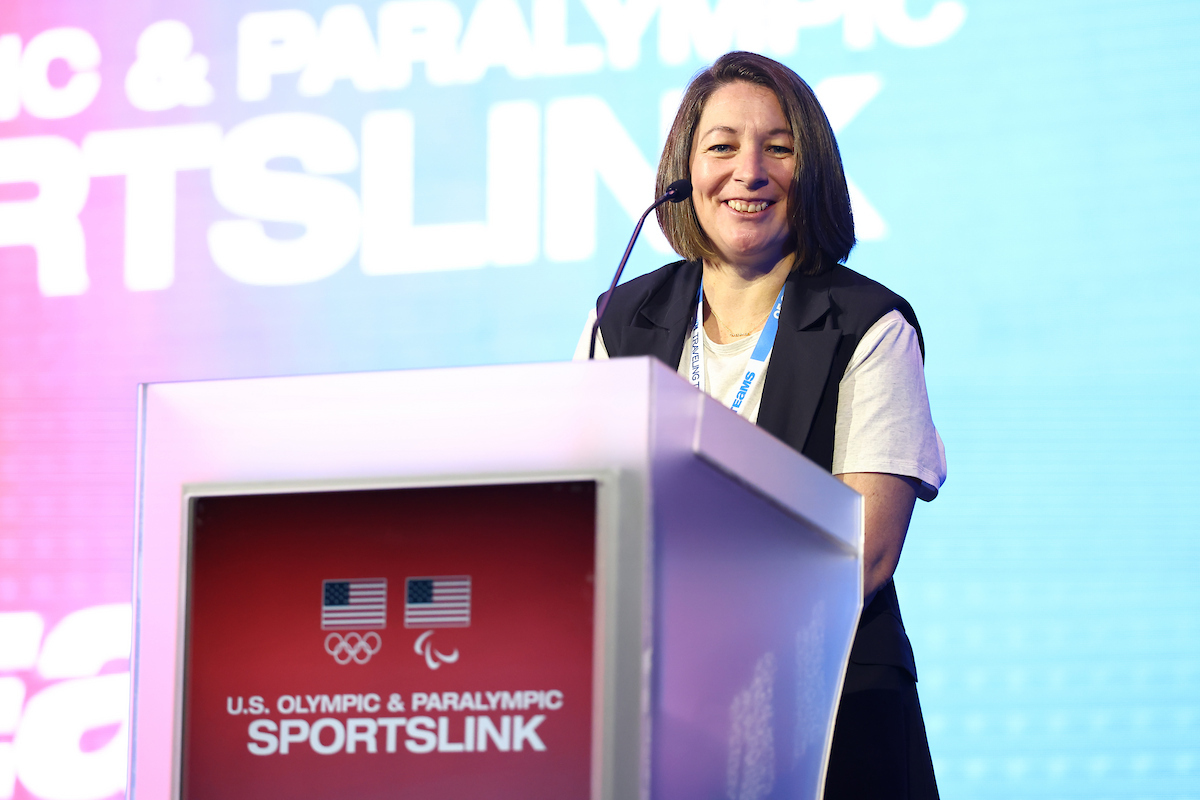
At the TEAMS Conference & Expo in Columbus, Ohio, attendees heard insights from a wide range of Olympic national governing bodies provide updates on their organizations. The updates were part of the U.S. Olympic and Paralympic SportsLink program that is co-located at the conference.
Below is an overview of the updates shared.
USA Fencing
USA Fencing CEO Phil Andrews shared that the sport has been doing well since the 2024 Olympic Games in Paris, where Team USA tied for the most medals. The organization has added 8,000 members since then, making it one of the fastest growing sports in the Olympic movement. USA Fencing recently hosted its national championships in Milwaukee, Wisconsin, which was the largest fencing event to date and won the 2025 SportsTravel Award for Best Amateur Sports Event presented later at TEAMS. In 2026, USA Fencing will open a private high school academy and performance center in Stow, Massachusetts. According to Andrews, the college pipeline is strong.
“Our athletic directors tell us that they value fencing as a sport in their programs,” he said. “We’re thrilled to hear that the NCAA provides significant training opportunities for Americans who go on to make the Olympic and Paralympic teams.”
USA Fencing also is changing how athletes will qualify for competitions, requiring them to go to more regional events to make it to the national level.
“That should open up more opportunities for us to go to slightly more convention centers,” Andrews added.
Finally, he addressed the “issue of the year:” transgender athlete participation.
“The challenges are going to be how do your state laws interact with that particular subject,” he said. “We’re keen to discuss more with our city partners.”
USA Gymnastics
Stefanie Korepin, chief programs officer for USA Gymnastics, announced a new event: a national competition for the women’s Xcel program in 2027. She also revealed that the organization was launching its search for a host at TEAMS, and that they’re expecting thousands of athletes to attend. The Xcel program is a recreational commitment track that was developed about 10 years to fill a need because gymnasts were leaving the sport at a young age.
“Gymnastics was becoming so hard that the commitment required as they moved up the levels became unattainable for some of these athletes,” Korepin said. “So USA Gymnastics created a program that was designed to be fun and accessible. It captures the kid who wants to do gymnastics, but they also want to play soccer, and they also want to sing in the school choir and they also want to go to prom.”
Last year, the number of participants in the women’s Xcel program surpassed that of the women’s development program — the traditional development pipeline at USA Gymnastics — for the first time.
On the other end of the spectrum, Korepin announced that the organization is bringing back the American Cup (past winners include Mary Lou Retton, Kurt Thomas, Nastia Lukin, Gabby Douglas and Simone Biles). However, instead of the traditional format, the competition will be a mixed gender team, resulting in a new medal for gymnastics at the Olympics.
“We are going to format the American Cup to mirror what we hope the format will be at the Olympic final at LA28,” she said.
USA Wrestling
Since 2022, USA Wrestling has experienced double digit growth, said director of national events Pete Isais. The sport reached an all-time high of 372,000 members last year. He attributed a massive driver of that number to women’s wrestling, which has jumped to 18 percent from 12 percent of the NGB’s total membership in three years, accounting for nearly 57,000 female members.
“Women’s wrestling is now the fastest growing high school sport in the United States, and this March they will have the first NCAA women’s national championship in Coralville, Iowa,” he said.

Participation numbers at events are skyrocketing as well. The largest wrestling tournament in the world, the Junior and 16U Nationals has grown by 28 percent over the last four years.
USA Wrestling is opening the bid process for three events: the Women’s Nationals, Women’s National Duals, and Kids Freestyle and Greco-Roman Nationals.
“Our primary bid factors are volunteers, venue enhancements, safety and experience, and internet cost and high-quality streaming,” said Isais.
USA Rugby/World Rugby
Consultant Mick Hogan outlined an exciting eight years for USA Rugby/World Rugby. Their current focus is on the 2028 Olympics and then the Men’s World Cup, the third largest sporting event in the world, in 2031 in the United States, marking the first time the tournament will be held in North America. Two years after that, the Women’s World Cup will also be held in the United States, bringing together the 16 best women’s teams in the world.

The sport has also seen substantial growth in events: In 2023, the organization held only one match. By the end of this year, it will have hosted 14 matches and that number will jump to 17 in 2026.
“A real uptick in not just the volume of events, but also the scale of them,” Hogan said.
USA Team Handball
USA Team Handball has won more medals in the last 12 months than the past 30 years combined, according to CEO Michael King.
The biggest event that is currently open for bid is the International Handball Federation’s World Beach Tour finals in November 2026. King encouraged CVBs to submit a proposal for the event, whether they have beachfront or not.
“We can put sand anywhere,” he noted.

Every April, USA Team Handball hosts a collegiate national championship. The sport now has more than two dozen teams, which is the largest it’s ever been.
“We’re always happy to start looking at growing outside of campuses now that we’ve gotten to a certain scale,” he said.
King also announced a new national training site at Indian River State College in partnership with Florida’s Play Treasure Coast.
USA Judo
Judo is a very small sport in the United States, as noted by USA Judo CEO Corinne Shigemoto. About 30,000 people participate in the country, but an estimated 50 million people practice worldwide.
“Going into LA28 we’ll see some growth, we’ll see some spikes,” she said. “We just need to make sure that we capitalize on that.”
The organization holds four national events per year: the Youth Nationals in March, the Senior Nationals in May, the Junior Olympics in July and the President’s Cup in November.

“To run an event, we need 40,000 square feet, unobstructed. Bleacher seating preferred,” said Shigemoto. “If you’ve got that, we want to talk to you.”
USA Judo is looking for bids for 2027, 2028 and 2029, and they recently changed their model for sourcing events, taking it in-house instead of using a third party.
U.S. Figure Skating
U.S. Figure Skating is in the midst of its largest Olympic campaign that it has ever run.
“Our membership numbers have continued to increase, but we would love to see a significant bump coming out of Milan,” said Annie White, chief commercial officer for the national governing board.
The NGB is also working with the international federation to try and get synchronized skating into the 2034 Olympic Games. The sport consists of 12 to 16 athletes skating at the same time, and White described it as “dance meets cheer on ice.” That event is open for bid for the next four years.
“It’s very exciting, it’s very loud,” she said. “And it’s a great opportunity for us to make the Winter Games gender neutral.”
More competitions that are open for bid for the next four years are Skate America and the U.S. Figure Skating Championships.
“If you have ice, we would love to chat with you,” White said.
USRowing
According to Tom Rooks, USRowing’s chief sport officer, rowing has the most scholarships at the NCAA level for women. The sport is growing not only in opportunities, but also across destinations.
“The sport that’s often thought of as kind of Ivy League centric, if you look around suddenly we see Texas and Alabama and Tennessee,” said Rooks. “Funny enough, places for football are becoming rowing meccas.”
Like some of the other national governing boards, USRowing has the largest membership than ever before, and has witnessed a 60 percent growth following the summer national championship in 2024.
Rooks announced a new rowing competition that will take place at the 2028 Games: beach sprints. Here’s how it works: two people run down the beach, jump in a boat, crash through the waves, come back to the beach, jump out of the boat, run up the shore and the first one to hit the buzzer wins.

“We’re very excited about this,” he said. “It’s much more viewership potential than we normally get. It’s great for spectators.”
Thanks to Safeguarding, a range of measures to promote both physical and psychological well-being, rowing has seen a dramatic decrease in harm to athletes.
“Wherever harm comes from, it’s the same,” he said. “Whether we lose an athlete to emotional abuse, physical abuse, or carelessness or neglect, it doesn’t matter the source.”









 Copyright © 2026 by Northstar Travel Media LLC. All Rights Reserved. 301 Route 17 N, Suite 1150, Rutherford, NJ 07070 USA | Telephone: (201) 902-2000