

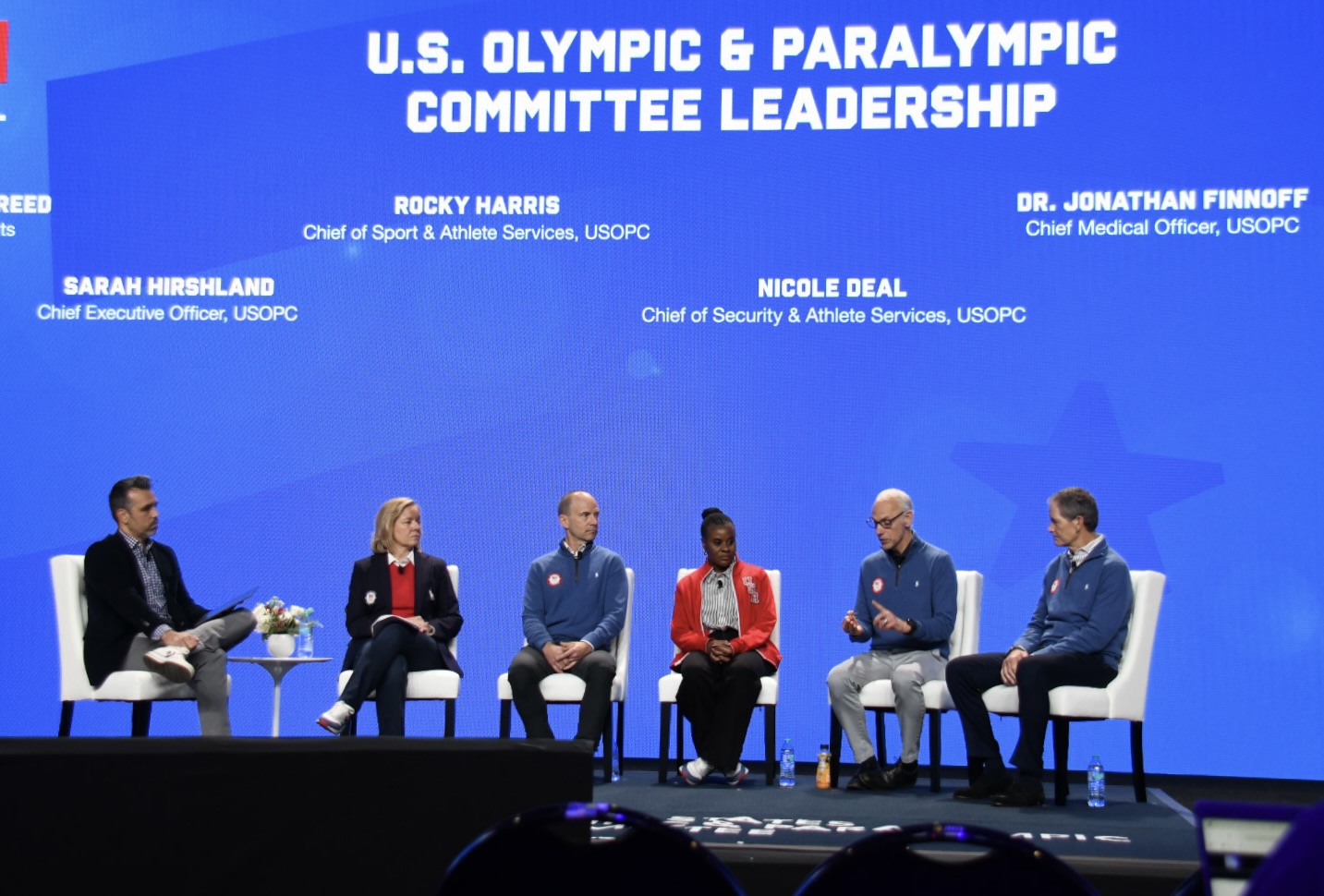
With 100 days to go until the Olympic Winter Games in Milan-Cortina, Italy, leadership at the U.S. Olympic & Paralympic Committee are expressing confidence in a complex plan to keep athletes at ease and healthy during a Games that will feature six event clusters over a wide geographic range.
At a media summit in New York to mark the milestone countdown, USOPC CEO Sarah Hirshland and other leadership noted that programs the committee put in place years back have set the team up for success, including a renewed emphasis on winter sports. Team USA expects to send 225 Olympic and 69 Paralympic athletes to Italy, although only 14 athletes have qualified so far for the Games.
“It’s game time,” Hirshland said. “Anticipation is building, the training intensifies, as you can imagine. But the excitement is also building and we’re very, very encouraged by what Team USA promises to be by the time we get to Milan-Cortina. We’re feeling as bullish as ever about the winter team that we’ll bring with us in 100 days or less.”
Adding unique context to these Games will be a wide geographic footprint with most indoor events being staged in or around Milan, and mountain events in the Cortina region, several hours away.
“It’s a fragmented footprint, and frankly, that’s potentially an advantage for Team USA,” Hirshland said. “We pride ourselves on being the most prepared team out there, and so when there are challenges to fit into a footprint, our opportunity is to use that to our advantage, and that’s how we’re thinking about it. We’re preparing for all of the challenges and the fragmentation and the puzzle that it will give us. But it’s worth noting: Our athletes are comfortable in Italy. They compete there often. Many of them train there. So it is not a strange location for them.”
Rocky Harris, the USOPC’s chief of sport and athlete services, noted that the committee has been in regular conversation with national governing bodies about how to approach logistics around the event.
“We’ve had to be creative with our NGB partners to come up with the right service levels to make sure our athletes get all the services that they need, and we’re confident in our plan,” he said. “We’re really confident in Italy and the plans they have, and we saw even the sliding track open this week, and that was one of the venues that people were concerned about. So they’re ready, we’re ready.”
Spectators Need to Plan Ahead
Hirshland advised spectators planning to attend events in Italy to be judicious in their planning. Transportation between the urban clusters and mountain clusters will be a particular challenge at these Games.
“If you’re not anticipating or you haven’t focused on those distances, I think it could generate frustration,” Hirshland said. “So we’re telling everybody, build your plan properly and you’re going to have an amazing experience.”

But those distances and the planning involved have also allowed the USOPC to plan differently — in ways that may benefit future Games. Harris noted that collaboration with NGBs began early in the process. And the decentralized nature of the Games will give the USOPC a gameplan for all future events, including those that end up with a more compact footprint.
“Now we have a formula for if it’s decentralized,” he said. “We know how to handle it, and we know really how to collaborate better and what the needs are of each NGB. I think it’s brought us closer to our NGB partners and collaborating more with them. I think the opportunity for us going forward when we look at what we can learn from Milan-Cortina in this is going to not only help us in the Summer Games in L.A., but in future Games as well.
Keeping Team USA Athletes Safe
The USOPC also addressed plans for securing athletes on the ground, a process that becomes more challenging given the widespread nature of event venues, said Nicole Deal, the USCOC’s chief of security and athlete services.
“The Team USA team behind the team won’t be able to be at all the locations all the time, so we’re working with our partners at the U.S. Department of State and engaging with diplomatic security agents so they can be in those physical areas where we’re not able to be,” Deal said. “They’ll be serving as force multipliers for our security team, making sure Team USA athletes have the resources, and that security and comfort that they’re used to, even though we won’t be able to physically be there all time.”
Athlete preparedness also extends to the physical and mental health of athletes as well. Dr. Jonathan Finnoff, the USOPC’s chief medical officer, noted that 15 pallets of medical equipment will be shipped to Italy in an effort to keep Team USA’s athletes as physically healthy as possible.
According to Finnoff, 30 percent of Olympic athletes and 45 percent of Paralympic are either injured or ill during the Games.
“They still compete, they still train, but they’re not going to achieve their personal best if they’re not healthy,” he said. “We know that on an average if you’re ill, you drop about four places, so if you are going to be a gold medalist, you’re now in fourth place. So it’s super, super important to go into the Games that our athletes are healthy.”
One piece of advice? The USOPC advises its athletes to sit near the middle of the plane and by the window to limit exposure to airborne threats from other passengers. In addition, Finnoff advises athletes to turn the overhead air so it blows between themselves and the passenger sitting next them to limit exposure to germs.
NHL Returns to the Games
Harris also addressed the return of NHL players to the Olympic Games, with the league returning for the first time since 2014.
“We’re thrilled to have the NHL back in the Games,” he said. “We think that’s going to do a lot, not only for the sport of hockey, but for our country to get excited about the Games in a way that we have not in quite some time.”

As for including those players in the USOPC’s athlete preparations, Harris noted that there are nuances with professional athletes. While the USOPC is committed to building athlete pipelines for the women’s hockey team at tge Olympics and sled hockey teams in the Paralympics, the men’s team of professional athletes offers a different dynamic and focus, which will include a specialized and shortened training camp.
“It’s pretty hands off, quite frankly, with the NHL players,” he said. “Now it’s about the right coaching and the right game plan. USA Hockey has that in place right now, we’re really confident in that. But I would say, overall, we’re thrilled that the NHL is back and that the players are back across the world, not just for Team USA. It’s going to bring a new level of excitement that we haven’t seen in 12 years.”








 Copyright © 2026 by Northstar Travel Media LLC. All Rights Reserved. 301 Route 17 N, Suite 1150, Rutherford, NJ 07070 USA | Telephone: (201) 902-2000