

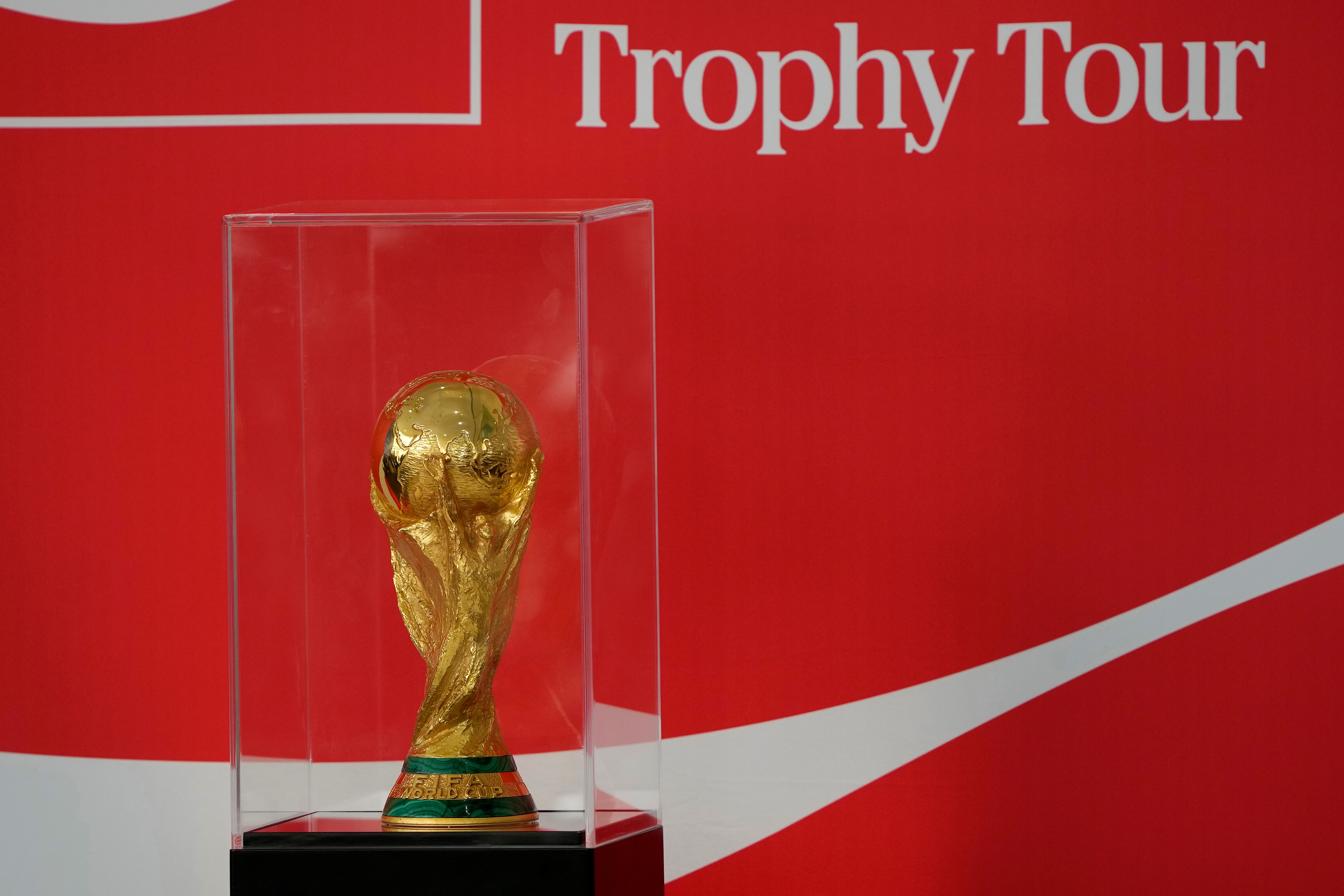
March 3 marks a milestone for FIFA: 100 days until the long-awaited start of the men’s Word Cup in North America. The first game will take place between Mexico and South Africa in Mexico City on June 11.
The groups for the tournament were determined at December’s FIFA World Cup Final Draw held at the John F. Kennedy Center for the Performing Arts in Washington, D.C., in front of nearly 2,000 international guests, before the match schedule was officially confirmed 24 hours later.
For the first time, the competition will feature 48 teams (an increase from 32 in 2022), including 12 groups of four national teams, and a new round-of-32 as part of the knockout stage. It is also the first time that the FIFA World Cup will span three countries (Canada, Mexico and the United States) and 16 host cities, including 11 in the U.S., and there will be a record 104 matches, all leading up to the championship match July 19 at MetLife Stadium in New Jersey.
In total, 42 teams have already qualified for international soccer’s showcase event, while the remaining six will qualify via continental and inter-continental play-offs later this month.
However, with 100 days to go until the tournament gets underway, there are still pain points to address. Here are the top concerns for FIFA and local organizers to address:
Mexico’s Hosting Concerns
Last month, a number of soccer matches were cancelled in Mexico after the killing of a high-profile Mexican drug lord — Nemesio Ruben Oseguera Cervantes, otherwise known as “El Mencho” — led to cartel violence in at least 20 states across the country.
Mexico City, Guadalajara and Monterrey are set to stage 13 of the 104 scheduled matches at this summer’s tournament, including all three of Mexico’s Group A matches, one Round-of-32 match and one Round-of-16 game.
In addition, the South Korean, Colombian (Guadalajara, Jalisco) and Uruguayan (Playa del Carmen, Quintana Roo) Men’s National Soccer Teams have already confirmed their team base camp training sites and hotels in Mexico during the World Cup. Other countries’ national teams have still not announced their final base camps and six more teams still need to qualify altogether.
Although the violence prompted calls for FIFA to relocate World Cup matches in Mexico to elsewhere in Canada or the United States, FIFA officials and President Gianni Infantino said that his organization was not concerned about the turn of events with regards to hosting the tournament in June.
Iran Tension
The tension in the Middle East, heightened by Israel and the United States’ missile strikes on Iran and the latter’s retaliatory attacks on military bases and residential areas in Qatar, the United Arab Emirates, Israel, Kuwait, Saudi Arabia, Jordan, Bahrain and Cyprus, has thrown Iran’s participation in the 2026 FIFA World Cup into serious doubt.
Over the weekend, rumors emerged that Iranian national team officials were considering withdrawing from the tournament due to political tensions in a move not seen in decades. Austria (1938), Türkiye (1950), Scotland (1950), France (1950) and India (1950) have previously withdrawn from the tournament due to a mix of reasons, including Austria’s occupation by Nazi Germany and because India was not allowed to play barefoot.
FIFA Secretary General Mattias Grafström stated that the organization would “communicate as we always do with the three (host) governments” and that “everybody will be safe.”
If Iran were to withdraw, it may be that FIFA invites a replacement team from the Asian qualifying section to participate in the tournament. This could be Iraq, which is due to compete in an intercontinental play-off with Bolivia and Suriname later this month, or the United Arab Emirates, the next best-placed team in the Asian qualifying section and which is looking to qualify for its first Men’s FIFA World Cup tournament.
Iran is due to compete in Group G alongside Belgium, Egypt and New Zealand. It has also selected a team base camp training site in Tucson, Arizona, to use between traveling to matches and staying at its hotel.
Immigration Crackdown
Iran is one of at least 75 countries whose citizens are restricted or banned from entering the United States due to a directive issued by President Donald Trump, which currently effectively prevents Iranian fans from attending the tournament.
President Trump’s immigration crackdown has led to the suspension of the processing of immigrant visas for citizens of at least 15 World Cup-qualified nations, including Algeria, Brazil, Cape Verde, Colombia, Egypt, Ghana, Haiti, Iran, Ivory Coast, Jordan, Morocco, Senegal, Tunisia, Uruguay and Uzbekistan, who may not be able to attend.
Fan Festivals
All 11 U.S. host cities were originally planning to organize large-scale Fan Festivals during the tournament. However operational concerns over stadiums and funding from FIFA means that plans for some official celebrations are being amended.
In New York New Jersey, a FIFA Fan Festival that was slated to be held in Liberty State Park has now been canceled, with Queens and Manhattan now due to host smaller-scale activations separately. While the event is still set to be free in Manhattan, as is customary during FIFA World Cups, the Festival in Queens is selling tickets for $10 — the first time that FIFA has ever charged for one of its official fan festivals.
Elsewhere, the majority of Fan Festivals in other cities remain free but are due to run on a smaller scale and for a shorter length. This is evident in Seattle, for example, where the originally planned 500,000-capacity event has since been split into a number of mini-festivals in smaller venues due to high municipal costs and logistical and security concerns.
The hosting of the World Cup and the official FIFA Fan Festival in Boston is in doubt after the city of Foxborough — home to Gillette Stadium, which is hosting matches — said it was still waiting on state funding to cover security costs for the events, including police and public safety expenses. It is being reported that Boston requires $7.8 million in funding to cover these costs by the end of March in order to approve the World Cup license by a March 17 deadline, but this funding is currently being held up by a partial federal government shutdown. Even then, the Boston Fan Festival would only be open for 16 of the 39 days that the tournament will last.
Likewise, Miami, Kansas City and New Jersey are seeking similar assurances from World Cup organizers in order to cover security and safety costs. Hosting official Fan Festivals is an expensive business — in all, they are estimated to cost up to $1 million per day each.
ICE Intervention
The fatal shooting of Renee Nicole Good in Minneapolis in January thrust the Immigration and Customs Enforcement agency into the national and global spotlight, leading to clashes with protesters and raising concerns that ICE would enforce immigration laws on a more widespread scale when fans visit the United States for this summer’s World Cup.
ICE’s involvement at this year’s tournament matches is dictated by the U.S. federal government, namely the Department of Homeland Security, as opposed to individual host city organizing committees. Traditionally, these agencies play significant roles in the safety and security provisions of large-scale sporting events, with the aim to protect the public from potential disorder.
Pricing and Affordability
Pricing and affordability remain key issues for fans traveling to matches at the 2026 FIFA World Cup. An analysis by The Guardian indicated that there was a tenfold increase in some tickets for this year’s edition compared to Qatar 2022 and that even the so-called “cheap seats” were at least three times pricier in most rounds than they were for the same competition four years ago.
For the first time ever at a World Cup, FIFA employed a dynamic pricing — or “variable pricing” — strategy where ticket prices shift according to demand and match popularity. The practice is common particularly in the U.S. entertainment industry but it is largely unknown territory for soccer fans traveling over from other countries, and many have been priced out of matches altogether.
Such was the anger around escalating ticket prices, FIFA countered a fans’ backlash by announcing a new dedicated ticket pricing tier — the Supporter Entry Tier — that makes tickets available at the fixed price of $60 for each of the 104 matches, including the final. However, this applies to only around 2% of all 2026 World Cup tickets, raising further questions around accessibility.
On top of the games themselves, fans will deal with increased costs for hotels and other short-term accommodation, driven by demand from soccer fans. Fans that decide to drive to matches will also face parking costs of up to $175 per vehicle if they park on stadium facilities.
Extreme Heat
The 2025 FIFA Club World Cup, which served as a warm-up to this summer’s showpiece event in the United States, demonstrated how players struggled in extreme heat conditions during play.
With three months to go until the 2026 FIFA World Cup, a report from Pitches in Peril has found that 10 of the 16 venues across Canada, Mexico and the United States are at “very high risk of experiencing extreme heat stress conditions,” reaching more than 82 degrees Fahrenheit / 28 degrees Celsius, as per The Met Office in the UK. Such were the conditions last year, matches were played at a slower tempo and substitutes decided to stay indoors in their locker rooms rather than sit on the bench in intense heat.
FIFA is trying to mitigate against the heat by using cooling breaks at every World Cup game, regardless of the weather. Every game will pause 22 minutes into each half, giving players an opportunity to take in scheduled refreshments.










 Copyright © 2026 by Northstar Travel Media LLC. All Rights Reserved. 301 Route 17 N, Suite 1150, Rutherford, NJ 07070 USA | Telephone: (201) 902-2000