

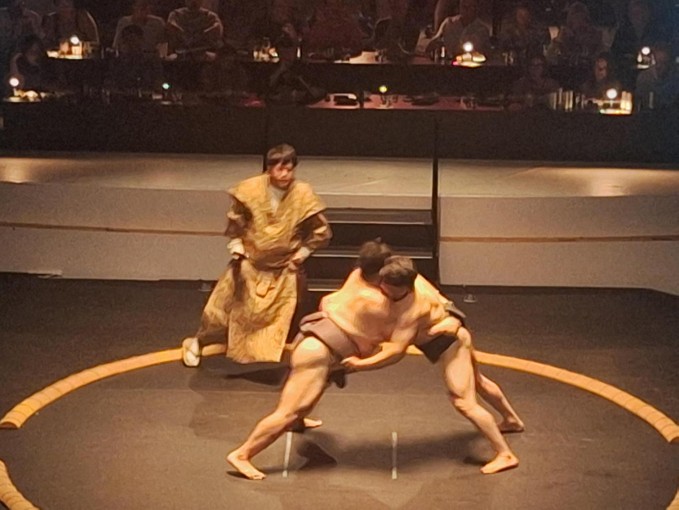
It might be stating the obvious to say that Borough Hall, Greenwich, in London, is a world away from Japan. But on a sweltering summer’s night in the capital, the site was transformed into a sumo wrestling venue that would not have looked out of place alongside the arenas in Tokyo, Osaka, or Nagoya that are known for their fervent atmospheres.
The sport, which debuted in Japan more than 1,500 years ago and originated as agricultural prayers for harvests, is experiencing an unexpected surge in global exposure of late. Amateur sumo events have already been organized in more than 85 countries, including a Grand Sumo Tournament in London’s Royal Albert Hall (in partnership with the Japan Sumo Association) and the Tournoi de Sumo de Paris earlier this year (after more than three decades away from the French capital), while a new professional sumo league will launch this fall in the United States.
That the London tournament sold out in minutes tells its own story, but it also points to a growing fascination with Japanese culture in general. Scroll through social media, and it isn’t hard to find hundreds of travelers and content creators listing the cuisine, natural landscapes, and vibrant cities as reasons to visit the country.
Data from the Japanese National Tourism Organization indicates that there were more than 42 million foreign visitor arrivals to Japan last year — a 17 percent rise on 2024 figures and a nearly 33 percent increase on pre-pandemic trends from 2019. For those who want to visit Japan but have not yet, an intimate sumo experience in a city like London is the next best thing, and event organizers are keen to capitalize on this burgeoning demand.
‘A Live Dining and Performance Experience’
The London event I attended (which will soon head to Manchester) was organized by a company called Tokyo Nights, guided by Event Director Matthew Harris, and produced by experiential company Cerebrum Ents. In Harris’ own words to Reuters, he says that Tokyo Nights is “effectively an immersive sporting dining show” which “establishes a narrative foil based on the creation myths of Japan” and combines professional sumo wrestling with premium Japanese dining.
Premium ticketholders can expect to eat premium Japanese food and drink sake, whiskey, or craft cocktails, all while watching sumo wrestling ringside, but all attendees can feel the anticipatory energy even from the balcony overlooking the dohyō.
It is also the first time that this particular tournament is taking place in Europe. It may not be the most prestigious event in the sport’s calendar, but the sumo wrestlers are performing authentic bouts and set out to deliver genuine, competitive matches for the audience.

The narrative of the tournament revolves around an interactive round-robin tournament, with three rounds consisting of two fights to qualify for either the third/fourth place play-off or the Grand Final. Four retired professional sumo wrestlers (rikishi) are split into competing teams (heyas) based on mythical guardians, leading up to the climactic bout to crown the undisputed champion as the Tenko Muso — translating directly as “The One Who is Peerless Under Heaven.”
Without weight or height divisions in sumo, the rikishi fight each other in the round-robin phase, and all have alluring nicknames such as Vermilion Bird, White Tiger, Black Tortoise, or Azure Dragon to honor their ancient guardians.
Energy and Respect
Upon entering the arena, each guest is assigned a heya and wrestler of their own to support, according to which side of the venue they are sitting on (north-, south-, east-, or west-facing). As the compere psychs up the audience, it creates a degree of rivalry and hostility on all sides of the arena, but the overriding sentiment is always about respect for the rikishi (booing is forbidden).
This is a sport that is steeped in both religion and history. At the beginning of the tournament, highly choreographed, traditional shokkiri rituals must be carried out to demonstrate illegal moves (kinjite) and banish evil spirits from the dohyō ring, but they are also included for comedic factor in less serious matches as the fighters shift their weight onto one leg and slam down.

There are other rituals and customs to set the scene too.
Before a match, a gyōji (referee employed by the Japan Sumo Association) blesses the dohyō, and in this case there was the bizarre sight of the referee wearing a bucket hat with a Union Jack flag to remind us which country we were in. Fighters then squatted down and showed their palms to the sky to indicate that it will be a fair fight without weapons, and the bout only began when each one felt the time was right, stirring up added tension and anticipation as the initial hushed silence lifted.
For those of us unfamiliar with such customs and rituals, there is thankfully some help at hand. Two commentators were positioned beside the dohyō (including one Irish sumo expert called Finn) and their role was to explain all of the rules before the matches and analyze any of the 82 finishing moves or elimination tactics (including dropping one’s knee behind the loser’s knee, stepping outside of the ring, etc) after the matches.
Two hours later, my brother and I were still engrossed in the action as our fighter Suzaku (nicknamed the Vermilion Bird) defeated Genbu (Black Tortoise) in the Grand Final, sending our heya into raptures.
We had seen what sumo was all about, and why it is growing in popularity — energy, respect, and tension in equal measure.










 Copyright © 2026 by Northstar Travel Media LLC. All Rights Reserved. 301 Route 17 N, Suite 1150, Rutherford, NJ 07070 USA | Telephone: (201) 902-2000