

Editor’s Note: This is part of SportsTravel’s ongoing Olympic preview week. Check back each day this week for more.
February 2: What to expect at the 2026 Winter Olympic Games, by Jason Gewirtz
February 3: Previewing each venue — and whether they’ll all be ready, by Paul Stevens
February 4: Looking back 20 years at the last Winter Games in Italy, by Ted Keith
February 5: Athletes to Watch, by Paul Stevens
February 6: Previewing the Opening Ceremony, by Paul Stevens
Two decades ago, Andrea Bocelli stepped onto the stage at the Stadio Olimpico into what the beloved Italian tenor would later call “an atmosphere that only the Olympic Games can create.”
It was a freezing cold night in Turin in February 2006, yet Bocelli still managed to deliver a rousing performance of “Because We Believe” that helped bring the last Olympics in Italy to a close. Nearly 20 years later to the day, Bocelli on February 6 will help launch the latest edition of the Games in his home country with a performance at the Opening Ceremony in Milan’s San Siro Olympic Stadium.
Beyond establishing Bocelli as the only star to take part in both Games, it promises to be a moment connecting one era to another. It will also be part of a ceremony that will remind the world why it should still believes in the power of the Olympics. In advance of this year’s Olympic Winter Games in Milan Cortina, SportsTravel is traveling back in time two decades to explore how the Games have changed between stops in Italy.
Tourism and Venues
With a population of 900,000 at the time, Turin was the largest city ever to host the Olympic Winter Games, a position now held by Beijing, the host of the 2022 Games. Turin was best known as the home of automotive company Fiat, and had a well-deserved reputation as an industrial center. After the Games were awarded in 1999, however, the perception of the Piedmont region began to shift significantly. Buoyed in part by the Games, tourism spiked in the area, from eight million in 2000 to 12 million in 2010 to 15 million in 2018.
The Games cost a reported $3.4 billion to produce, and the resulting financial impact for the country was similarly significant, with one report pegging the economic benefit to Italy at approximately $17.4 billion Euros ($20 billion). The Games also helped launch the city of Turin into the modern age, as its first underground metro system opened just days before the Games got underway.
The venues used for the Games also proved sustainable. Twelve of the 14 competition venues from those Olympics are still in use, most notably the Stadio Olimpico, which is home to Serie A’s Torino Football Club, and the Oval Lingotto, which hosted speedskating competitions and is now a frequent site of trade fairs. The Olympic cauldron is no longer aflame, but its soaring height of at 187 feet, at the time the biggest ever (which did the work that two cauldrons will perform this year) is a lasting reminder of when Turin welcomed the world to Italy.
Tech and Media
In today’s media environment, people expect content on demand, and the Games in Milan Cortina stand ready to meet that requirement. Twenty years ago, however, that kind of access was mostly a pipe dream, but it was the Turin Games that ushered in a new era with a series of technological milestones: the first to provide live video coverage on mobile phones (and this in a pre-iPhone era), the first to have live streams online and the first to broadcast in events in HD.
NBC Universal was in the midst of a 12-year, $5.7 billion rights deal to carry the Olympics (compared to the $7.75 billion extension it’s operating under this cycle), including $613 million for Turin. Still, the network repeatedly got routed by competition such as “American Idol” on Fox and “Grey’s Anatomy” on ABC (OK, so not everything has changed in the past 20 years), and while a decline compared to the U.S.-based Salt Lake City Games of 2002 could be expected, the 36 percent drop from four yers prior was nevertheless a steep one.
This year’s Games, of course, will have to meet an ever-changing world of media consumption habits. The most recent Olympic Winter Games drew an average of 10.7 million viewers in the U.S. per night on television, a substantial drop from the 17.8 million four years earlier in Pyeongchang. However, there were 4.3 billion minutes streamed on digital and social media.
Nations and Events
In 2006, a then-record 80 countries took part in the Games. Three nations — Albania, Ethiopia and Madagascar — were in the Winter Games for the first time, while Serbia and Montenegro made its only Winter Olympics appearance. By contrast, 92 nations will be in Milan Cortina. Among the newcomers over the last 20 years: Andorra, Benin, Bolivia, Saudi Arabia and Trinidad and Tobago.
The Turin Games had 84 medal events, a record at the time, in 15 disciplines. This year’s Games will feature 116 medal events —another record — in 16 disciplines. The new discipline? Ski mountaineering, which will have three medal events.
Scandal Era
The Turin Games took place in an athletic era rife with scandals related to performance-enhancing drugs, one that would come to ensnare everyone from baseball’s Barry Bonds to cycling’s Lance Armstrong. Though vigilant in guarding against doping, the Games nevertheless were tarnished by the events of February 18, when Italian military police raided the home of Austrian biathlon and cross-country ski teams and the IOC gave unannounced doping tests to Nordic skiers from that country.
Though the tests were negative, the following spring, six Austrian athletes were banned from the Olympics for life based on materials seized by the police during the raid.
This year’s Games will strive as ever to be clean, but will take place just three months before the first Enhanced Games, which allow athletes to use performance-enhancing drugs.
Memorable Moments
No matter where they are held, or what the cost of the venues, or however strange the mascots (Turin’s Gumby-shaped Neve and Gliz, roughly meaning “snow” and “ice,” were practically normal compared to what other Games have offered), the Olympics always succeed in their primary mission: delivering unforgettable sporting achievements.
That was certainly the case in Turin. The host nation didn’t have much to celebrate — its medal count of five golds and 11 total was good for just ninth overall — but it found a new hero in speedskater Enrico Fabris, who won two of those golds as well as a bronze.
Shizuka Arakawa won the first figure skating gold medal ever for Japan in women’s singles.
Germany won the overall medal count for the second straight Winter Games, claiming 29 medals, while the United States again finished second, though its total of 25 was nine fewer than it claimed in Salt Lake City.
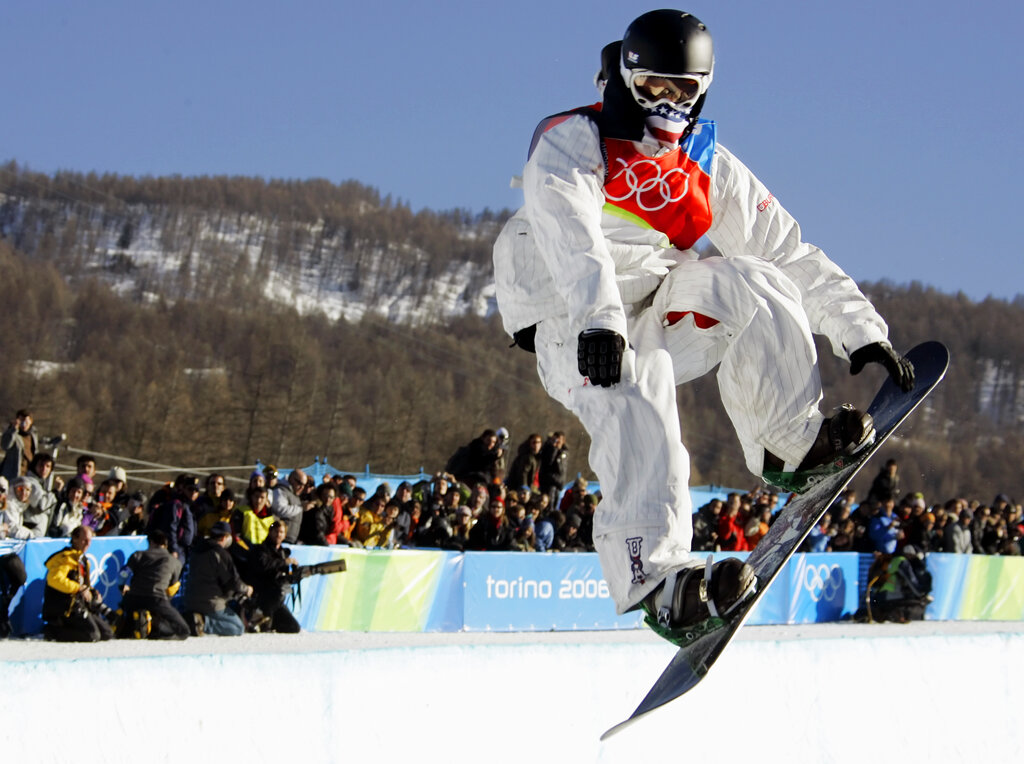
Ted Ligety (men’s combined) and Julia Mancuso (women’s giant slalom) won gold on the ski slopes, while snowboard legend Shaun White won his first of three Olympic golds in the halfpipe. This will be the first time since 2002 that the Winter Games have taken place without White, who is now scoring off the slopes as the founder of The Snow League, a professional halfpipe circuit that resumes its first season later this month with an event in Aspen after the flame goes out in Italy.
Perhaps the biggest name going into and coming out of the 204-member U.S. team was speedskater Apolo Anton Ohno, who didn’t disappoint. Ohno won three medals, including a gold in the 500 meters.
Fellow speedskater Joey Cheek also won two medals, one of which was gold, but his greatest feat may have been what he gave, not what he got. Cheek donated his $40,000 bonus from the then-U.S. Olympic Committee to Right to Play, a humanitarian group aimed at giving children better opportunities. That sparked a run of similar donations that totaled more than $500,000 by the time the Games ended, and which earned Cheek the right to be the U.S. flag bearer at the Closing Ceremony.
In a Games of success and scandal, Cheek had given everyone a reason to believe.










 Copyright © 2026 by Northstar Travel Media LLC. All Rights Reserved. 301 Route 17 N, Suite 1150, Rutherford, NJ 07070 USA | Telephone: (201) 902-2000